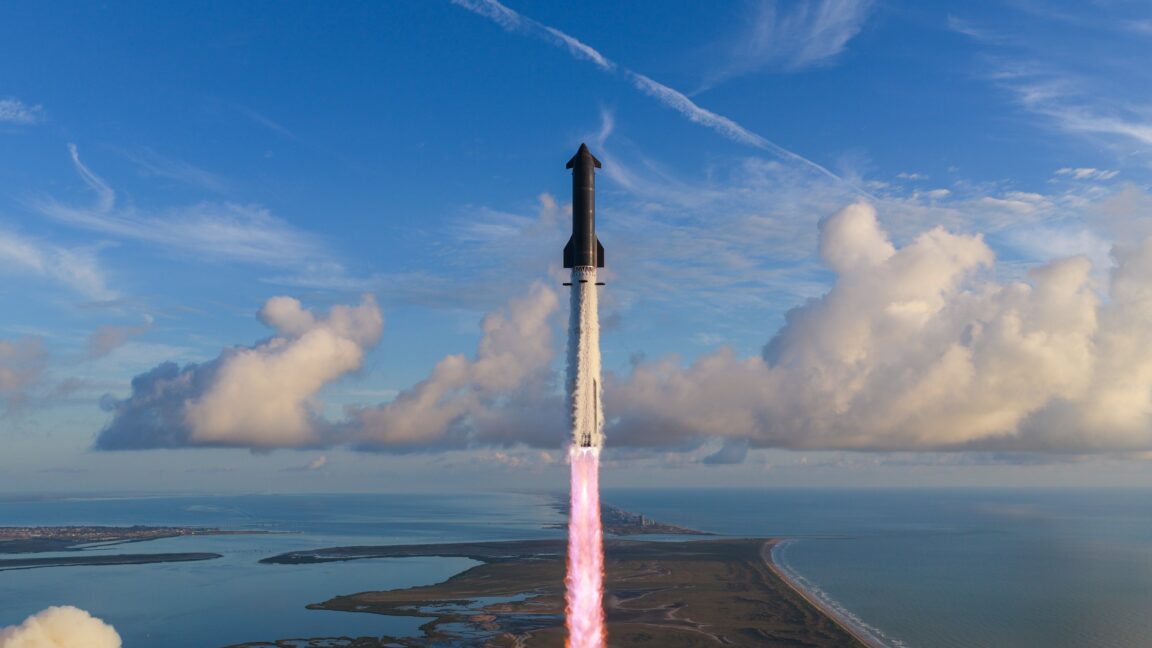
SpaceX’s Starship rocket thundered into the sky over South Texas early Monday. It was the 14th test flight of the world’s most powerful launch vehicle. This time, however, the rocket’s massive upper stage squeezed out some extra oomph from its Raptor engines and accelerated to orbital velocity.
On all of Starship’s previous flights, SpaceX intentionally dialed back the full capability of the rocket to fly a suborbital trajectory, slow enough for Earth’s gravity to pull the vehicle back into the atmosphere before it could complete a full lap around the planet. After several successful suborbital flights in a row, SpaceX officials decided this launch should go all the way to low-Earth orbit. What’s more, SpaceX packed 26 of the company’s newest generation of Starlink broadband satellites into the rocket’s cargo bay.
One by one, the flat-packed satellites—too large to fit inside SpaceX’s workhorse Falcon 9 rocket—were released from Starship’s payload deployer using a system of pulleys and cables to eject the satellites overboard like a Pez dispenser spits out candy. Starship Flight 14 began with a booming sendoff from Starbase, Texas, at 8:49 am EDT (7:49 am local time; ) as 33 methane-fueled Raptor engines pushed the 407-foot-tall (124-meter) rocket off its launch pad. The engines generated up to 18 million pounds of thrust to propel the fuel-laden rocket into the sky over Starbase, SpaceX’s private spaceport just north of the US-Mexico border.
Heading east from South Texas, the rocket powered through the speed of sound and soared into the stratosphere before its Super Heavy booster stage detached from Starship’s upper stage. The booster executed a rapid high-altitude turnaround to begin thrusting back toward the Texas coast. Several minutes later, the Super Heavy first stage made a controlled splashdown in the Gulf of Mexico just off the coast of Starbase.
The upper stage continued its climb into space before shutting off its Raptor engines a little more than eight minutes into the fight. Up to this point, the rocket followed a similar trajectory as SpaceX’s previous Starship test flights.
Extract — continue reading at the source.