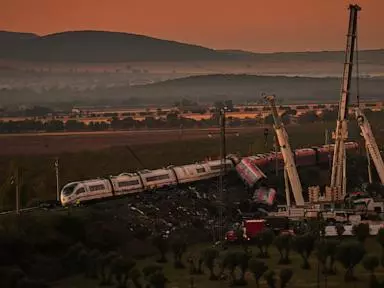
Spain's second major train collision this year has sparked debate over whether human error or rail network failures are to blame BARCELONA, Spain -- Was Spain's second major train collision this year caused by human error or failures in its once touted high-speed rail network? Spain’s transport minister was quick to lay most of the blame a traffic controller’s poor judgment for Wednesday's collision in Toledo province, which killed 69 people. But railway unions are pushing back.
They point instead to what they describe as deteriorated working conditions — fewer traffic controllers with more work than ever — that have made it increasingly difficult to ensure the safety of 45 million passengers annually. A judge and a special government commission are conducting separate investigations into the deadly crash, while Spanish Prime Minister Pedro Sánchez has pledged to get to the bottom of it. The system, called LZB, monitors the position of trains and can even trigger the automatic braking of a train to prevent a collision.
That malfunction meant that human controllers based at a control post in Madrid took over full responsibility for monitoring the positions and safety of the trains on a stretch of 63 kilometers (39 miles) between Madrid and Seville. At that time authorities believe there were six trains on the affected stretch of track. At 8:36, a controller told one train, belonging to the state-owned RENFE company, that it could start running again at normal speed.
The other train, operated by privately owned IRYO, located 15.5 miles (25 kilometers) down the line, also tried to restart, but the engineer was unable to override the automatic stop and informed the controller. At 8:53 the collision occurred, derailing carriages and shredding parts of the trains to bits. It was the second major crash on the Madrid-Seville line this year.
In January, over two hours further south, one train jumped the track and hit another train going the other direction, killing 46 people. Transport Minister Óscar Puente, who is under pressure to resign, called the controller's decision to let one train restart at full speed while the other remained still “inexplicable” and “erroneous.” Puente said that the RENFE train should never have been told to start moving again since there was still a stop signal active on that line. The decision “was taken in inexplicable circumstances given that a train was stopped and with a red light," he said.
Unions, however, argue that the context matters. Raquel Ayllón, spokesperson for SCF, Spain’s railway traffic controllers union, told The that the workload is regularly too much for the current staff to safely handle. She said that traffic controllers have been asking for more personnel for years, while the safety systems keep failing.
Extract — continue reading at the source.