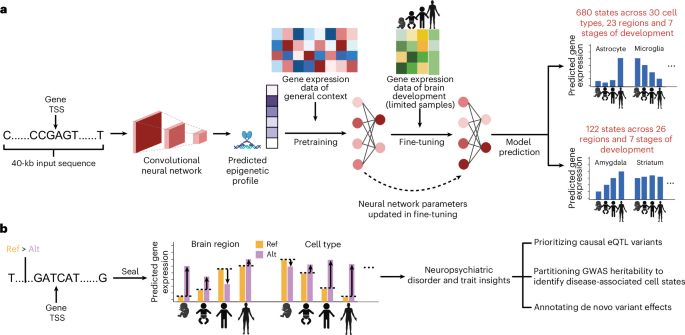
Understanding how genetic variation shapes gene regulation in the developing human brain remains a central challenge in neuroscience, particularly in transient cell types and developmental stages where data are limited. We present Seal, an interpretable artificial intelligence (AI) transfer learning framework for genome-based modeling of gene expression and variant effects with spatiotemporal resolution across 26 regions, 30 cell types and 7 developmental stages. Seal predictions provide mechanistic interpretation by linking variants to transcriptional regulators in a spatiotemporal context.
Applying Seal to genome-wide association studies, we identify shared and distinct regulatory architectures across six neuropsychiatric conditions that align with clinical trajectories. In the Simons Simplex Collection autism cohort whole-genome data, Seal uncovers a significant burden of de novo regulatory variants in transient fetal excitatory neurons, revealing cell-type-specific and stage-specific effects. By connecting genetic variation to spatiotemporal regulatory programs, Seal offers a general framework for uncovering mechanisms of human brain development and disease.
This is a preview of subscription content, access via your institution Access Nature and 54 other Nature Portfolio journals Get Nature+, our best-value online-access subscription Receive 12 print issues and online access Prices may be subject to local taxes which are calculated during checkout All data used to train and evaluate the Seal model are publicly available. The URLs are provided in the Supplementary Notes. This study did not generate new experimental data.
The trained Seal model parameters are available at Zenodo (https://zenodo.org/records/14104608 (ref. 70)). The source data required to run the Seal model are available at Zenodo (https://zenodo.org/records/13368284 (ref. 71)). The Seal framework code is available at https://github.com/FunctionLab/Seal.
Implementation of the framework requires Python v.3.10+ and the Python package PyTorch (v.2.2 and higher). The data files required to run the Seal framework can be downloaded by following the instructions in the GitHub repository. L., Beesley, J., French, J.
Beyond GWASs: illuminating the dark road from association to function. Genet. 93, 779–797 (2013). Article CAS PubMed PubMed Central Google Scholar Ashley, E.
Extract — continue reading at the source.