Massachusetts is proud of its ties to the American Revolution. From Paul Revere’s Ride to the siege of Boston, the past year-plus has been devoted to celebrating 250 years of US independence. Yet during this time, the state, and New England in general, has given far less attention to an older, more complex remembrance: The 350th anniversary of King Philip’s war.
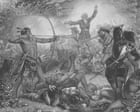
King Philip, or Metacom, was an Indigenous leader from the Pokanoket people. Alarmed by English colonists’ infringement of Indigenous rights, from seizing land to proselytizing, Metacom led an alliance of New England tribes – including the Pokanoket, Nipmuc and Narragansett – in an existential struggle for control of the region. He gave his name to the conflict, but paid with his life – as did many others, soldiers and civilians alike.
With an estimated 800 dead on the colonial side, and three to five thousand Indigenous slain, the war claimed more deaths per capita than any other in colonial American or US history. For the Indigenous, the price of defeat was steep. The victorious English sold many into slavery, and executed others on Boston Common.
The war marked a turning point in relations between the ascending colonial presence and an increasingly diminished Indigenous population, whose ancestors had met for a peaceful Thanksgiving celebration just a half-century before. Today, the conflict continues to reverberate. With November marking both National Native American History Month and the Thanksgiving holiday, and 2026 marking 250 years of American independence, historians are reflecting on the impact of King Philip’s war, 350 years later – a somber moment amid the Revolutionary hoopla.
Mack Scott III, an assistant professor of critical Native American and Indigenous studies at Brown University, and a member of the Narragansett tribe, says, “The way we remember it, when we do talk about it, is through ideas that become part of the lore of a nation, that we don’t even associate with the war but are definitely internalized as a community, as a people, as a nation: ‘This is the process by which the land becomes the US, and the process has some sort of benevolence.’ “A lot of people believed that,” Scott says, “[for them] it was an almost undeniable natural process, almost inevitable, it was going to happen in this way. They don’t remember how violent the war was for New England. That was the thinking about those processes – it was a promised land.
When you frame it almost in those senses – it was almost inexorable, undeniable, natural, divine, supposed to happen – the removal of Indigenous people, the death of Indigenous people becomes almost preordained, natural, something you expect to see. Today, Native peoples are almost back-of-mind for most Americans.” The situation was much different in 17th-century New England. Metacom’s father, Massasoit or Ousamequin, held a powerful position as the leader, or sachem, of the Pokanoket. (The tribe has been connected to the Wampanoag people, although there is some dispute over this.) It was Ousamequin who helped the starving Pilgrims survive their first winter at Plymouth in 1620-21, and it was Ousamequin who joined in on that first Thanksgiving meal of coexistence.
Extract — continue reading at the source.