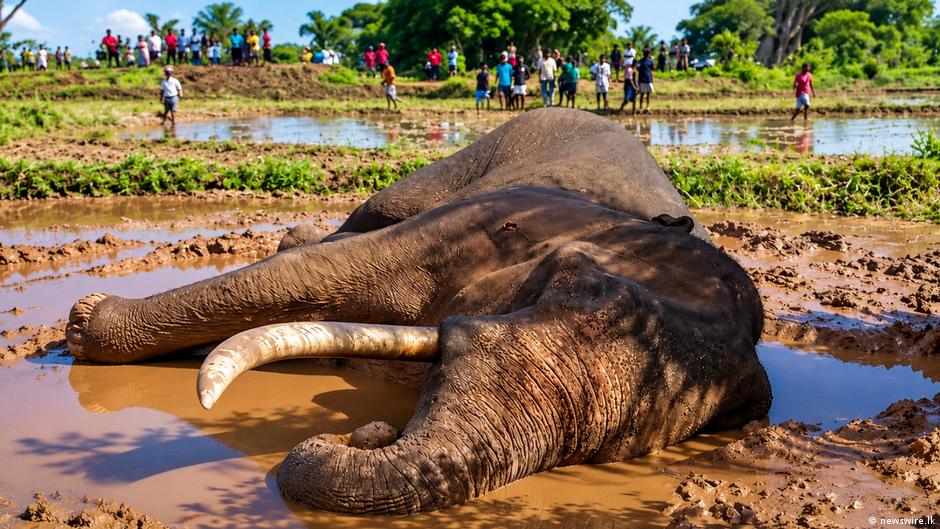
The recent death of an iconic male elephant in Sri Lanka has raised concerns over ongoing contact between humans and the giant animals who are quickly seeing their habitats reduced. The elephant known as "Kavantissa" had been considered to be the tallest living male elephant in the Sri Lanka. Thought to be anywhere from 45 years old and measuring roughly 3.3 meters tall (11 feet), he roamed Sri Lanka's northwest near the village of Galgamuwa, and was widely admired for his majestic stature.
In late September, villagers noticed the 5.5 ton-tusker (5,500 kg) was limping, and a closer look reveled a gunshot wound on his right leg. Despite the intervention of veterinary surgeons, the elephant died on October 16. Sri Lanka records the highest number of elephant deaths annually and the second highest number of human deaths globally from violent interactions between elephants and humans, which usually happen when crop raiding elephants encroach on farmlands.
According to official statistics, since 2019, 370 elephants and 125 humans have died on average in human-elephant conflict incidents. The situation affects the natural habitats of elephants and the livelihoods of rural communities. Home to about 10% of the global Asian elephant population and occupying about 2% of their total natural range, Sri Lanka has the highest density of Asian elephants in the world.
The Sri Lankan elephant is an endangered subspecies in the International Union for Conservation of Nature (IUCN) Red List of Threatened Species, and protected under Sri Lankan law, with punishment by fines and jail terms for wildlife-related offences. During the past few decades, forest cover in Sri Lanka has shrunk along with rapid population growth. Statistics show the rural population of Sri Lanka increased from 8.25 million in 1960 to 17.8 million in 2020.
Agriculture remains the primary source of income for these rural communities. As a result, the land is cleared for agricultural activities. According to Department of Wildlife Conservation (DWC) statistics, in 2024 an estimated 7,451 wild elephants were recorded in Sri Lanka.
About 70% of these wild elephants live outside protected areas. Research shows elephants have a massive daily dietary requirement of about 150 kilograms (330 lbs.) of green matter, which drives them into farmland. "Driven primarily by habitat loss, agricultural expansion, fragmentation of elephant corridors, and increasing competition for land and resources, human-elephant conflict continues to cause hundreds of elephant deaths and more than 100 human fatalities annually," said Ravi Corea, President of Sri Lanka Wildlife Conservation Society, a Sri Lankan non-profit conservation organization.
Extract — continue reading at the source.