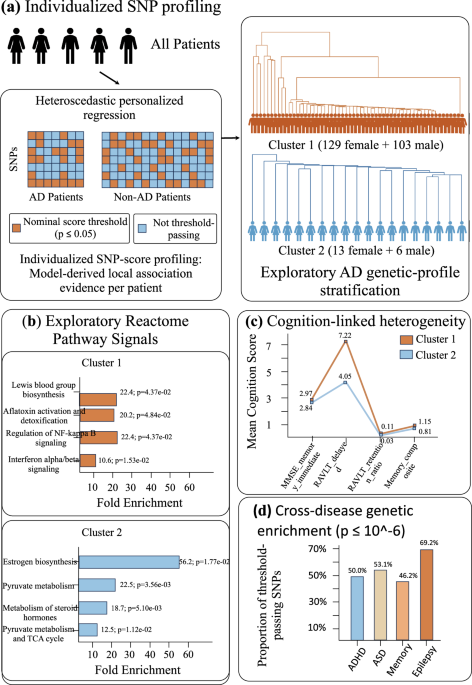
Alzheimer’s disease (AD) presents profound clinical and genetic heterogeneity that obscures its biological underpinnings and impedes therapeutic development. While genome-wide studies have identified population-level risk loci, the architecture of patient-specific genetic variation and its link to clinical outcomes remains poorly defined. Here, we introduce a heteroscedastic personalized regression (Het-PR) framework to move beyond cohort-averaged associations and construct individualized single-nucleotide polymorphism (SNP)-effect profiles for each subject.
Applying this method to the Alzheimer’s Disease Neuroimaging Initiative (ADNI) cohort, we identify an internally stable, exploratory genetic-profile stratification of AD patients into two subgroups that exhibit divergent performance across five cognitive domains. This finding suggests an association between model-derived individualized genetic profiles and cognitive impairment severity. Cohort-level analysis confirms that frequently selected variants map to biologically relevant, brain-expressed genes.
We further find that genetic variants previously associated with multiple neuropsychiatric and cognitive traits distinguish the AD subgroups under a label-permutation enrichment analysis, with epilepsy-associated variants showing the strongest proportional signal among the tested trait categories. These results suggest that AD heterogeneity may reflect shared genetic architecture across broader brain-related traits, including neuronal excitability-related loci such as sodium voltage-gated channel alpha subunit 1 (SCN1A). Our results provide an exploratory, genetically informed framework for studying AD heterogeneity, showing that model-derived individualized SNP-score profiles can reveal latent structure associated with cognitive and cross-disease genetic patterns.
Alzheimer’s disease (AD) presents striking biological and clinical heterogeneity that continues to obscure its mechanistic underpinnings and impede the development of effective therapies1,2. Despite decades of effort, therapeutic responses remain inconsistent across patients, and disease progression varies widely even among individuals with similar clinical diagnoses. Recent work increasingly suggests that AD is not a single entity but rather a spectrum of related conditions shaped by diverse genetic, pathological, and cognitive processes1,2.
Moreover, another study showed that apolipoprotein E (APOE) ϵ4 carriers with abnormal baseline tau levels experience faster decline at the group level while exhibiting greater variability within their own subgroup3. Therefore, understanding this heterogeneity and identifying its molecular correlates are central challenges in AD research. Multiple lines of evidence highlight the multidimensional nature of AD heterogeneity.
Genetically, AD encompasses both familial forms driven by highly penetrant mutations and sporadic forms whose risk architecture remains diffuse and only partially understood4,5,6,7,8. Sporadic AD in particular appears genetically diverse, with mounting reports that distinct subsets of patients harbor different constellations of risk variants7,8. Pathologically, recent studies have refined the long-standing amyloid hypothesis.
Extract — continue reading at the source.