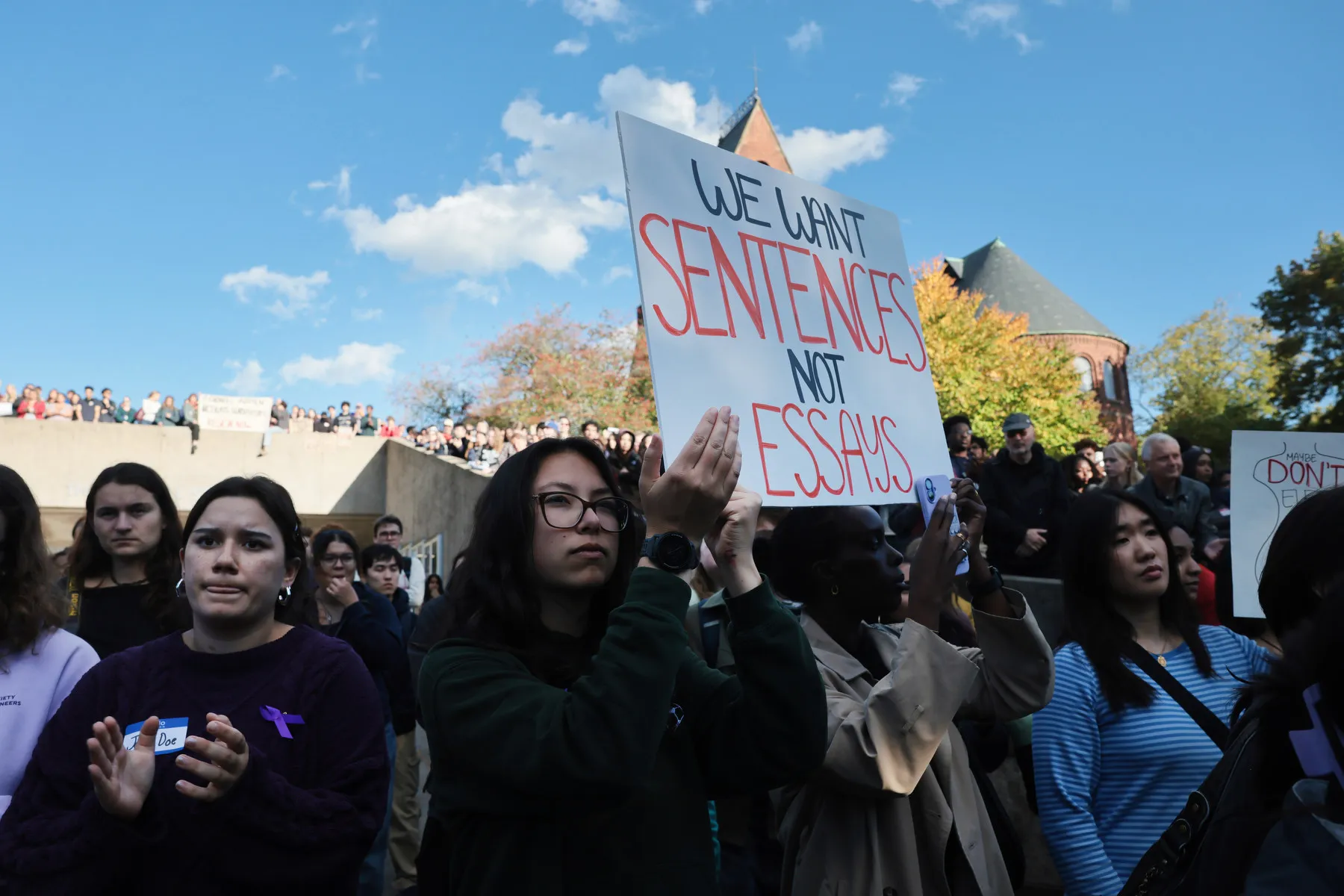
Keyanna Foster talks about sexual violence on her campus almost as if it were a class she started preparing for the moment she applied to college. Girls often hear stories of campus assaults while they are still in high school, she said. Foster entered Louisiana State University (LSU) knowing about 19-year-old Madison Brooks, a sophomore who was fatally struck by a car after she was reportedly raped by multiple men near an off-campus bar.
That same year, Foster said, some of her friends were also drugged or assaulted. For many women, the anticipation of violence has become part of the college experience. On September 14, LSU student Kendall Francis posted a now-viral TikTok video alleging she was raped by an LSU football player in October 2025.
The cases have reignited widespread outrage and a national debate about the pervasiveness of rape culture on college campuses. Survivors and student advocates are once again grappling with how to fight against sexual violence when they feel school officials and the government are failing to act. And all they have done, time and time and time and time again, is let the students down, and especially women,” said George Washington University (GW) senior Brianna Santoro, who is a co-president for GW’s chapter of It’s On Us, a national nonprofit program focused on sexual assault prevention.
Momentum against campus sexual misconduct surged during the early 2010s, after high-profile complaints against elite universities ignited public demands to improve the response from schools and the federal government. In 2011, the Education Department clarified in official guidance that on-campus assault and harassment are forms of sex discrimination prohibited under Title IX. But Title IX regulations can change substantially depending on the presidential administration, creating a moving goalpost for survivors seeking justice.
Late last month, the Education Department formally reinstated Title IX regulations issued in 2020 during President Donald Trump’s first term, replacing a rule adopted under former President Joe Biden that broadened the range of sexual harassment complaints schools must investigate. Organizations fighting campus sexual violence have long criticized the Trump administration’s rule, saying it has made reporting misconduct more difficult and relies on procedures, like courtroom-style live hearings and cross-examinations, which can retraumatize survivors. After a boy from a neighboring school assaulted her, she did not tell anyone for two years, she said.
She described the community where she grew up in Rhode Island as “pretty politically unequipped.” Her Indian mother and Italian father both have conservative views, and her family did not talk openly about sex and relationships, she said. At GW, she joined her campus chapter of It’s On Us, and found a space to “just be around people who know how to have an educated conversation and a trauma-informed conversation,” she said. The chapter launched in 2024 as a way to fill gaps in resources at GW, the chapter’s founder, Zoe Larkey, told the student newspaper at the time.
Extract — continue reading at the source.

/https://tf-cmsv2-smithsonianmag-media.s3.amazonaws.com/filer_public/00/48/004859f6-803c-4e8c-a05f-e3e91071fd36/second-generation-planet-artwork-credit-dr-snehalata-sahu_university-of-warwick.webp)


/https://tf-cmsv2-smithsonianmag-media.s3.amazonaws.com/filer_public/3c/5d/3c5d64ef-fa30-4bc1-89ee-af5a2f0e2667/7d56dae5-d789-46d6-9df7-cb274be80482_1.jpeg)