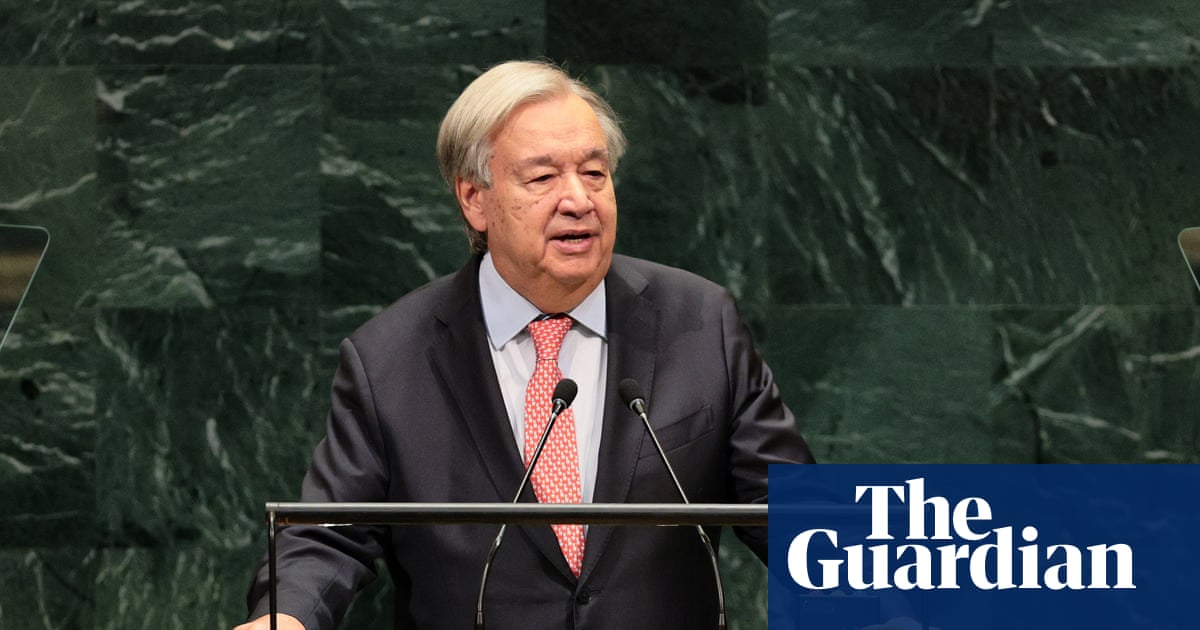
The world’s fault lines have turned from cracks into canyons as superpowers show that they alone do not have the military, economic and technological power to guarantee security, or solve the world’s problems, the outgoing secretary general of the United Nations has said in his final address to the general assembly. In a speech laced with despair but also glimpses of defiant hope, António Guterres warned that over the last decade, largely spanning his 10-year period in office “wars erupted with devastating consequences and dragged on with despicable cruelty. International law cast aside.
Geopolitical divides have deepened. Inequalities have intensified. The climate crisis went from distant warning to daily reality.
And artificial intelligence moved at a speed that has blind-sided even those who created it.” Without naming Israel, he also said the actions that followed the Hamas attack of October2023 “was an onslaught on Palestinians in Gaza, with a scale of killing and destruction unlike anything I have witnessed in all my years as secretary general”. He also rounded on profiteering energy companies for “treating the world as an open sewer”, described Africa’s omission from a permanent place on the UN security council as stunning, and called for a new compact to regulate AI. Throughout, the 77-year-old Portuguese politician and diplomat argued that a multilateral system centred on a newly representative UN was the only way to address this new convergence of problems.
However, he warned “at the very moment when humanity faces an unprecedented convergence of threats, our mechanisms for collective action are under growing strain”. Without mentioning Donald Trump once, he said what was required was “a recognition, especially by superpowers that their power isn’t so super. The events of recent years have made that unmistakably clear.
Military power alone cannot secure peace. Economic power alone cannot command stability. And technological power alone cannot guarantee security.” It was critical to avoid hegemonic tendencies and what Guterres described as the “great fracture” – the division of the world into two rival blocs with separate economic, technological and security systems.
The defining challenge of the age, he said, was that world governance, reflecting the power realities of a bygone age, was not adapting to the way power was being redistributed between and within states. At the same time there was “an extraordinary transfer of power away from governments to a handful of private corporations and individuals. Their reach now extends across politics, economies, information flows, technological development, and the civic space on which societies depend.
Extract — continue reading at the source.