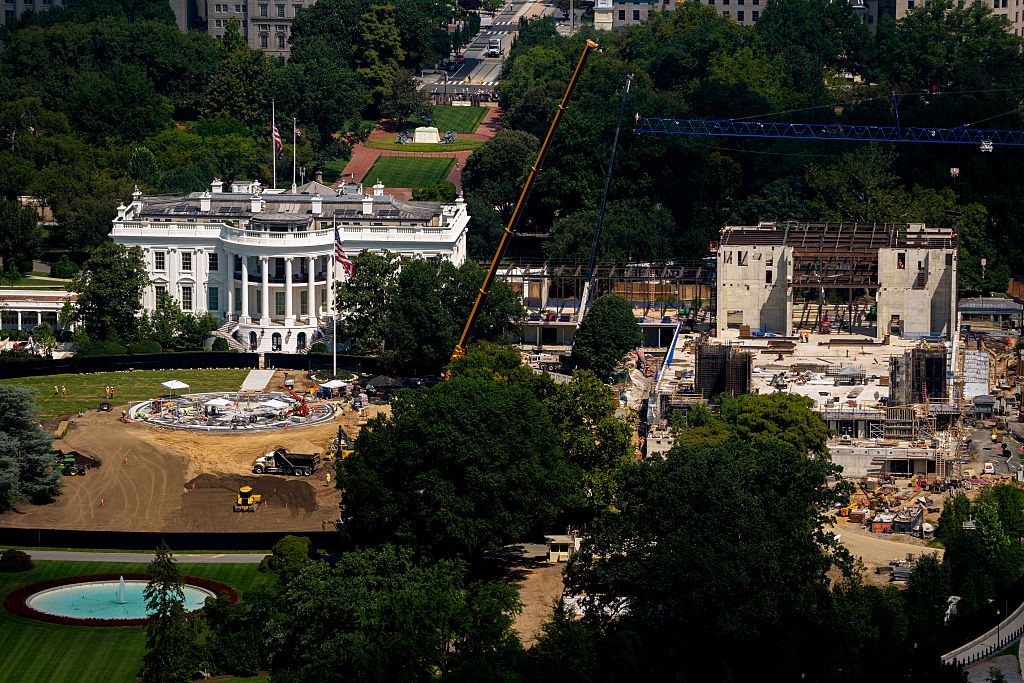
President Donald Trump’s $400 million, 90,000 sq ft White House ballroom is a step closer to becoming reality. The Supreme Court on Monday allowed Trump to move forward with construction of the ballroom, which had been partially blocked by lower courts. Divided 5-4, the Supreme Court granted an emergency request filed by the Trump Administration earlier in August, staying the lower court rulings.
The legal challenge to the construction, brought by the National Trust for Historic Preservation, argued that Trump did not have the authority to build the ballroom without congressional approval. The Supreme Court ruled on procedural grounds that the trust likely does not have legal standing to sue. The court did not rule on the legality of the construction.
We conclude only that, based on the submissions before us, the government is likely to prevail in showing that the Trust lacks ... standing to challenge the project in federal court,” the court said in its ruling. The decision comes after Chief Justice John Roberts issued a temporary stay on the lower court injunction on Aug. 21, allowing above-ground construction to proceed while the full court deliberated. Roberts ultimately was the only conservative justice to dissent, arguing that the project was “likely unlawful.” “The ballroom is a building or structure being erected on federal park grounds—President’s Park—in the District of Columbia.
Yet Congress has not passed any law resembling ‘express authority’ for the Executive’s construction of it,” Roberts wrote. Trump celebrated the legal victory in a Monday post on Truth Social. The project is part of Trump’s broader effort to leave a permanent legacy on the U.S. capital.
Since signing an executive order last March to “beautify” Washington, the Administration has completed a renovation of the Reflecting Pool, pursued an overhaul of the Kennedy Center, and announced plans to erect a 76m arch. Trump also began renovating the “horrible” front of the White House in July. The trust filed the lawsuit in December on behalf of one of its members, Alison Hoagland, an architectural historian and preservationist who lives in Washington.
Hoagland said in a declaration that she would “suffer both professional and personal injuries, including to my aesthetic, cultural and historical interests, if a ballroom of the proposed form and scale were constructed.” She argued that “an adjacent structure overshadowing the White House, exceeding it in height and massing, would diminish the primacy of the White House.” The Supreme Court’s majority said the trust likely lacked standing as the court had not previously recognized legal standing “in circumstances like these.” “To the contrary, we have repeatedly held that mere offense, disagreement, or distaste does not qualify as a concrete and particularized injury,” the court said. Roberts, in his dissent, wrote that a “historic preservationist such as Hoagland can be aesthetically injured in a concrete, particularized way by the transformation of a historic building that she frequently enjoys.” The trust also argued that the government needed the “express authority of Congress” to build on federal land in Washington, D.C. The Justice Department argued that the White House had authority for the construction under other federal statutes.
Extract — continue reading at the source.