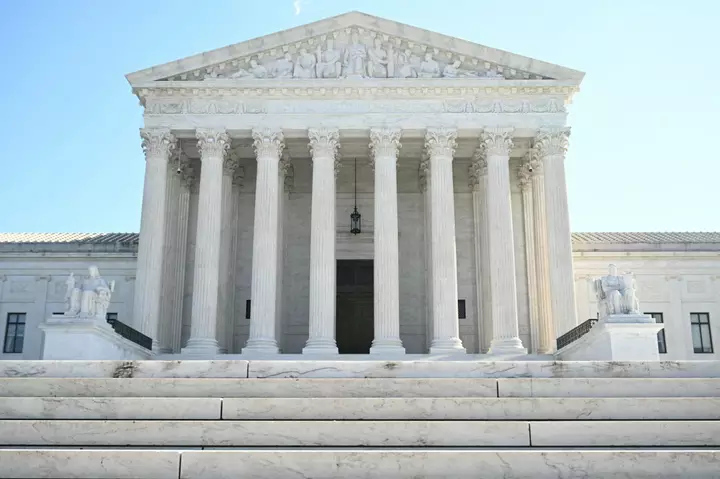
The Supreme Court has handed the Trump administration a 7-2 win in an escalating fight over discounted political advertising rates ahead of the midterm elections. In an unsigned order issued Wednesday in FCC v. Brown, the justices blocked a Fourth Circuit ruling that would have required the Federal Communications Commission to resolve a challenge to its political advertising policy within 48 hours.
The dispute concerns the FCC’s "lowest unit charge" rules, which require broadcasters to offer favorable advertising rates during the weeks immediately before an election. Four Democratic candidates, Sherrod Brown, Jon Ossoff, Roy Cooper and Kristen McDonald Rivet, have challenged FCC guidance extending those discounted rates beyond candidates themselves to political parties engaged in coordinated spending and some joint fundraising committees. The Supreme Court said the Fourth Circuit went too far when it ordered the agency to make a final decision within two days.
"The Fourth Circuit’s decision to issue an ‘extraordinary’ writ was inappropriate under the circumstances," the Court wrote. It added that federal law requires the FCC to rule on applications before it, but "does not obligate the Commission to act within a particular time frame." Justices Sonia Sotomayor and Ketanji Brown Jackson said they would have denied the stay. Newsweek has contacted the FCC and lawyers for the candidates for comment and is awaiting their responses.
Federal law gives legally qualified political candidates access to a broadcaster’s "lowest unit charge" during the 45 days before a primary and 60 days before a general election. In March, however, the FCC’s Media Bureau issued guidance stating that the discount could also apply to political parties engaged in coordinated political activity and joint fundraising committees that include noncandidate members. Brown, Ossoff, Cooper and McDonald Rivet challenged that interpretation, arguing that Congress reserved the discount for candidates themselves.
Their lawyers asked the full FCC to review the guidance. While that administrative challenge was pending, they also went to the Fourth Circuit, in August, a divided Fourth Circuit panel sided with the candidates and set aside the FCC guidance, holding that the statute limits the lowest unit charge to candidates. The Supreme Court stepped in on September 4 and stayed that ruling, saying the Fourth Circuit likely lacked jurisdiction because the candidates had gone to court before the full FCC had completed its own review.
This was the Supreme Court's second intervention in the dispute, on September 4, the justices stayed an earlier Fourth Circuit ruling that had struck down the FCC guidance. The Supreme Court said the Communications Act appeared to require the full FCC to decide the candidates' administrative challenge before they could seek review in federal court. Because Brown, Ossoff, Cooper and McDonald Rivet went to court while their application remained pending at the FCC, the Court said the Fourth Circuit likely lacked statutory jurisdiction to hear their challenge.
Extract — continue reading at the source.