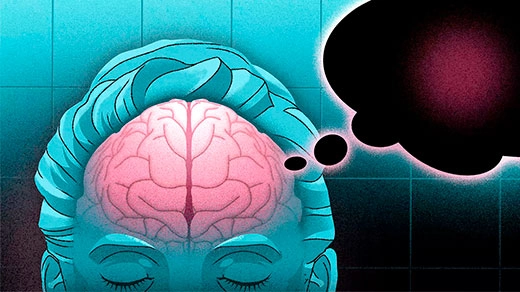
I walk through the dimly lit hallway, thinking of what’s in my fridge and what I should have for breakfast. With no real effort, I’ve navigated my environment, accessed my memory, and assessed the energetic state of my body, all in the space of a few seconds. How is the brain able to do this?
Partly by harnessing electricity. The brain spends about half of its energetic resources maintaining the electrochemical gradients that keep neurons poised and ready to fire at a moment’s notice. This gives the brain an extraordinary level of flexibility in responding to the demands of everyday life.
The collective electrical activity of many neurons can be seen as waves propagating through the brain from one region to the next, like the raised arms of enthusiastic spectators at a football game. New lines of research are revealing that these waves are more complex than previously known. Typically measured by electrodes, they have been identified as basic planar waves: simply structured oscillations in neural activity.
Neuroscientists have traditionally interpreted this as a bit like the sound of the brain’s engine revving, little more than a sign that it’s working. However, emerging evidence in humans and animals suggests that traveling waves play a central role in how the brain functions. Miller, a cognitive neuroscientist at the Massachusetts Institute of Technology.
In a study published in April 2026 in Nature Communications, neuroscientists measured traveling waves of neural activity and observed a menagerie: source waves that appear to emanate from one location, sink waves that converge on a spot, and vortexlike spiral waves. The team, which included Joshua Jacobs and Anup Das from the University of Chicago, found that different behavioral tasks were associated with distinct wave patterns. Neurons can change connections with their neighbors over time, but this usually happens on the scale of days or months.
Behavior, however, needs to adapt in seconds. A significant number of neuroscientists now believe these large-scale wave patterns may help to reorganize the brain in real time to meet the behavioral demands of waking life. When we pay attention, remember, or sleep, the large-scale frequency of the brain’s electrical activity changes.
Extract — continue reading at the source.




/https://tf-cmsv2-smithsonianmag-media.s3.amazonaws.com/filer_public/05/78/05782a4b-de8f-4169-98a8-407daac09187/noreaster.jpg)