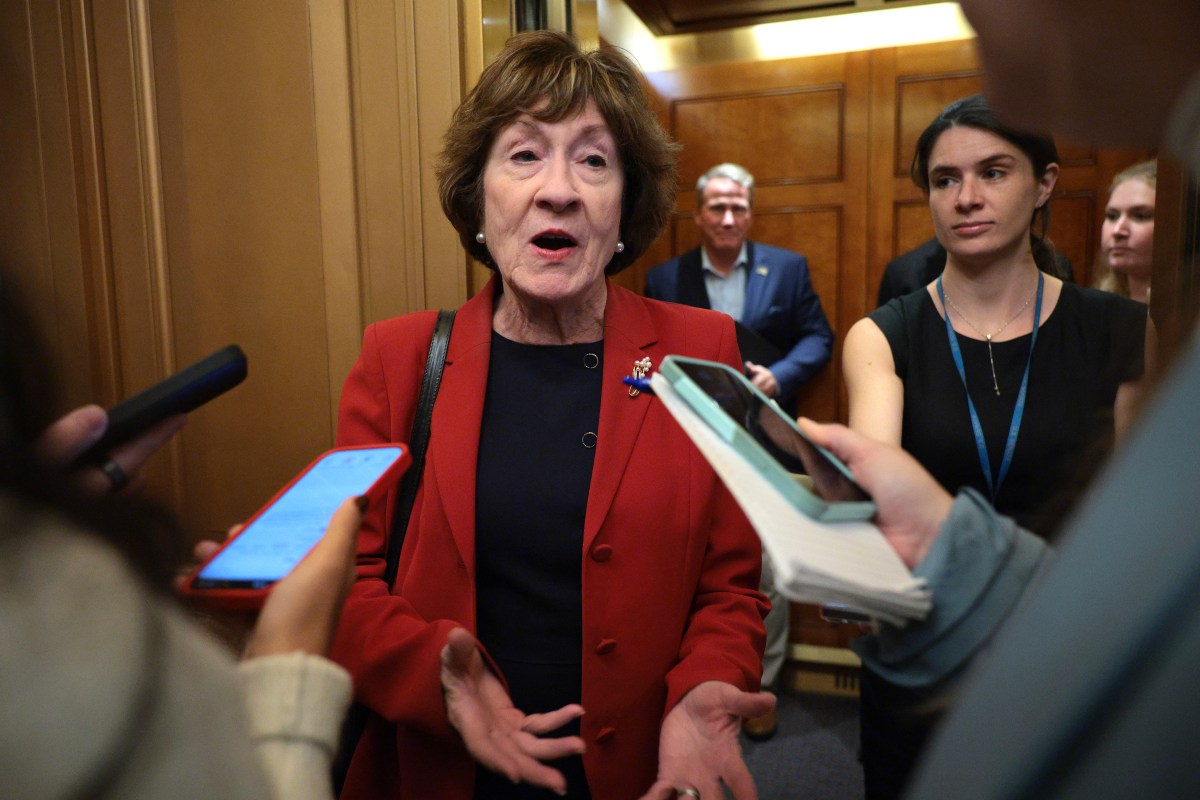
Maine’s Republican Senator Susan Collins has recorded another polling win over her Democratic rival Troy Jackson, but lingering questions about her alleged involvement in a kickback scheme and a related federal probe continue to cast a shadow over her campaign. Since Jackson entered the race as a replacement for Graham Platner—who dropped out in July following a sexual assault allegation, which he denies—the logger and former Maine Senate president has edged out the five-term senator in nearly every survey. Last week, however, a New York Times/Portland Press Herald/Siena survey gave Collins her first lead, and new polling from the data analytics firm co/efficient has offered her another edge over Jackson.
Of the 1,240 likely general election voters surveyed between September 28 and 30, 48 percent said they would vote for Collins compared with 46 percent for Jackson—a 2 percent edge within the poll’s margin of error—with 6 percent undecided. Newsweek has contacted both campaigns for comment. Though Democrats hold a slight polling advantage, election forecasters like RacetotheWH show a close contest for control of the Senate this year.
Maine’s seat has emerged as one of the most hotly contested and is therefore receiving particular attention alongside races in Ohio and Texas, among others. The Pine Tree State historically leans Blue and voted against Donald Trump in the 2016, 2020 and 2024 elections, though Collins has comfortably held her Senate seat since 1996 thanks to cultivating a reputation as a moderate Republican willing to work with the opposition on local and nationwide issues. However, her 2026 bid for re-election has been viewed as particularly tough, given contemporary voter frustration with the Trump administration and the economy—both key points of attack from the Jackson campaign.
In the co/efficient poll published on Wednesday, 44 percent said they had a favorable view of Collins as a candidate, with 47 percent viewing her unfavorably and 9 percent holding no opinion. Jackson appears to be lagging when it comes to recognizability, however, with 36 percent viewing him favorably, 47 percent unfavorably and a larger 16 percent having no opinion on the candidate. The poll had a margin of error of +/- 2.77 percentage points.
The pollster—identified as conservative-leaning by the watchdog MBFC—found that 53 percent of those surveyed dislike Trump and his policies, compared to 32 percent who support both Trump and his policies, 12 percent who dislike him but are in favor of his policies, and 3 percent who are unsure. Other recent polling has shown similarly thin margins between the two candidates—most leads falling within the pollsters' respective margins of error. Prediction market users favor Jackson as the eventual winner, though his odds on Polymarket have slid from over 70 percent to under 60 percent in the past week.
In September, the investigative outlet ProPublica published a report alleging that Collins had helped steer federal funding toward a defense contractor which had contributed to her political campaigns. The Federal Bureau of Investigation (FBI) probed the allegations at the time, though ProPublica notes that this investigation was shelved after Trump returned to office. An FBI spokesperson told ProPublica that the investigation had concluded years prior and "ultimately found nothing implicating Senator Collins.” Collins’s office likewise told Newsweek last week that she "cooperated fully" with the FBI during the investigation, and called the allegations outlined by ProPublica "categorically false." The issue continues to cloud Collins’s campaign, however.
Extract — continue reading at the source.