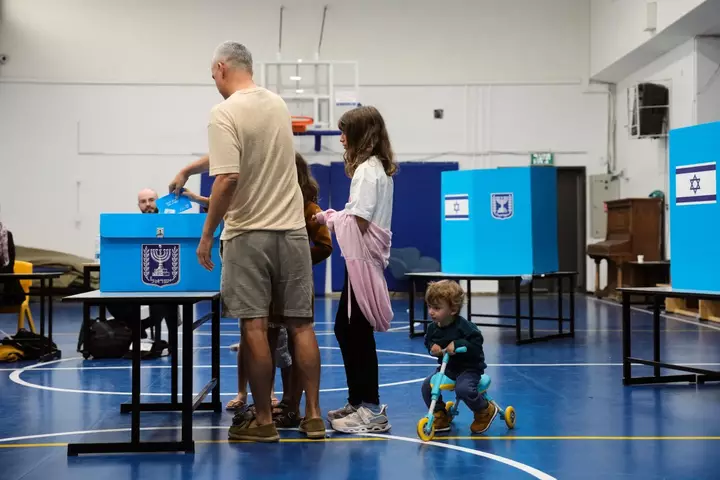
Israel's Arab voters emerged as a potentially decisive force in Prime Minister Benjamin Netanyahu's political future Tuesday after Channel 13's exit poll projected a divided parliament in which neither major political camp secured a governing majority. The survey gave Netanyahu's bloc 50 seats and the opposition bloc led by Gadi Eisenkot 53, leaving both camps short of the 61 seats needed to control the 120-member Knesset. The Arab-led parties were projected to win 17 seats.
The result, if confirmed by the official count, would make the relationship between Arab lawmakers and Netanyahu's opponents central to the next stage of Israel's political contest. Eisenkot's bloc and the Arab-led parties would together hold 70 seats. Yet their combined strength would only translate into a governing majority if enough lawmakers agreed on a political arrangement, a difficult prospect given longstanding divisions over cooperation with Arab parties.
Channel 13 projected 10 seats for the Joint List and seven for Ra'am, led by Mansour Abbas. Netanyahu's Likud emerged as the largest individual party with 25 seats, ahead of Eisenkot's Yashar with 23. The findings also suggest that the election has strengthened Likud relative to its final preelection polling, even as Netanyahu's existing alliance remains short of a majority.
Channel 13's October 23 survey had projected 19 seats for Likud and 16 for the two Arab-led parties combined. The figures expose a potential paradox: Netanyahu's opponents could command a substantial parliamentary majority on paper while remaining unable to agree on a government. Arab lawmakers may therefore hold influence over the outcome even if they never enter a governing coalition.
That prospect follows an election marked by record turnout at comparable times of day. Participation reached 55.7 percent by 4 p.m., compared with 47.5 percent in 2022, the highest figure recorded at that hour since comparable records began in 1973. Arab communities also reported unusually heavy voting.
Arab lawmaker Ahmad Tibi described participation as unprecedented, although a verified nationwide Arab turnout record was unavailable. Netanyahu responded by warning supporters about Arab participation and alleging election theft. "They are trying to steal the election from us," he said, referring to arrests of Ra'am activists suspected of voter bribery.
Extract — continue reading at the source.