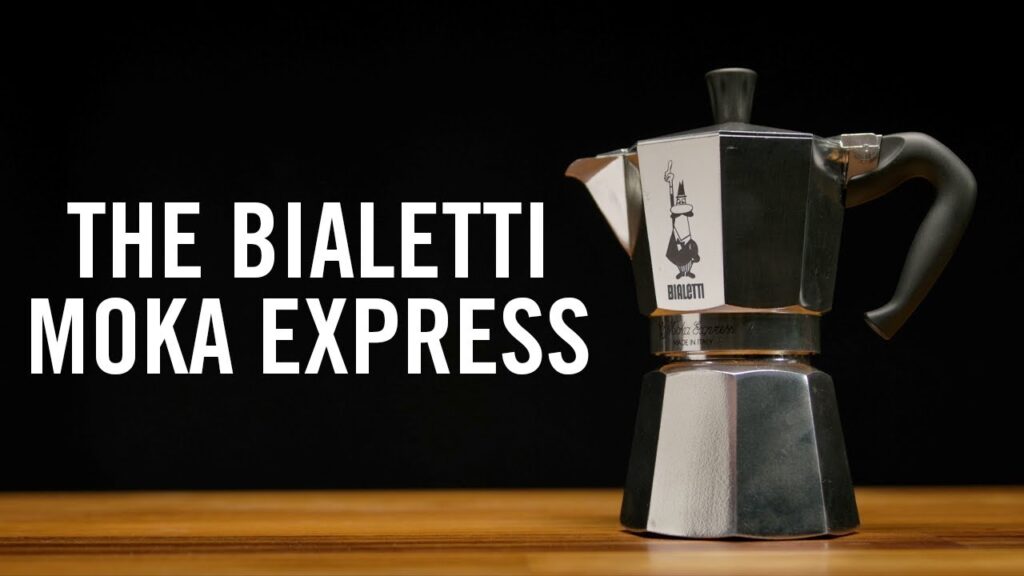
I am sure that many an Open Culture reader has a Bialetti Moka Express in their kitchen. I know I do, but I must add that I knew little about its history and apparently even less about how to properly use one. Coffee expert and author of The World Atlas of Coffee James Hoffmann introduces us to the appliance we think we know in the above video.
Alfonso Bialetti didn’t originally get into the coffee business. In 1919, the Bialetti company was an aluminum manufacturer, with the Moka Express invented somewhere around 1933 by Luigi de Ponti, who worked for the company. According to Deconstructing Product Design by William Lidwell and Gerry Manacsa, the inspiration came from Bialetti’s wife’s old-fashioned washing machine: “a fire, a bucket, and a lid with a tube coming out of it.
The bucket was filled with soapy water, sealed with the lid, and then brought to a boil over the fire, at which point the vaporized soapy water was pushed up through the tube and expelled on to the laundry.” As Hoffmann shows, earlier coffee-makers did use steam and a drip technique, but the Moka Express was the first all-in-one maker that could sit on the stove top and do the work. All the user had to listen for was the tell-tale gurgle when it finished brewing. In 1945, Alfonso’s son Renato returned from a prisoner-of-war camp and took over the family business.
He was instrumental in focusing on the Moka Express and turning it into an international coffee brand. He hired cartoonist Paul Campani to design l’omino coi baffi, “the mustachioed little man” whose image is on the side of every Moka Express, and who, during the 1950s, was in a series of humorous animated commercials. Bialetti was the pride of Italy, and for Italian immigrants living abroad, it was a treasured object in the kitchen.
Such was the identification of Renato Bialetti with the Moka Express that when he died in 2016, his ashes were interred in a giant replica pot. Hoffmann details the fate of the company afterwards, how it has fared against competitors in Italy and outside. Will it still be around in decades?
But it does make a great cup of coffee. And he shows the correct way to brew a cup with the Moka Express in this other video. Here are a few things I was doing wrong: not using hot water in the bottom to start; trying to pack in the ground coffee like I was making an espresso; using too fine a grind; and not cooling the bottom as soon as it’s done working its magic. (Note: a Moka Express coffee is somewhere between an espresso and a pour-over.) All these tips I’m going to try tomorrow morning.
Extract — continue reading at the source.
/https://tf-cmsv2-smithsonianmag-media.s3.amazonaws.com/filer_public/f6/c1/f6c13729-26b0-48eb-ba8c-9404f7b2ab3f/david_seman_1983631243.jpg)