In 2002, the retired British submarine lieutenant-commander turned amateur historian Gavin Menzies created a stir with a book about Chinese seafaring in the fifteenth century. 1421: The Year China Discovered the World (tellingly titled 1421: The Year China Discovered America in the United States) began as a global history of that year, only coming to focus on the claim of the title through the interventions of publishing-industry professionals. They no doubt sensed a lucrative controversy in the offing, and events proved them right. Not only did the book turn bestseller, it also managed the rare feat of drawing, among other responses, a two-hour PBS documentary dedicated to debunking it.
Today, 1421 is most charitably remembered as a work of historical fiction written around the idea that, even if China didn’t actually discover the world, wouldn’t it be neat if it had? That question is hardly as frivolous as it may sound. Much of Menzies’ book has to do with the exploits of Zheng He, a Ming-dynasty admiral and diplomat whose fleet really did make voyages to much of the world, or at least the parts surrounding the Indian Ocean.
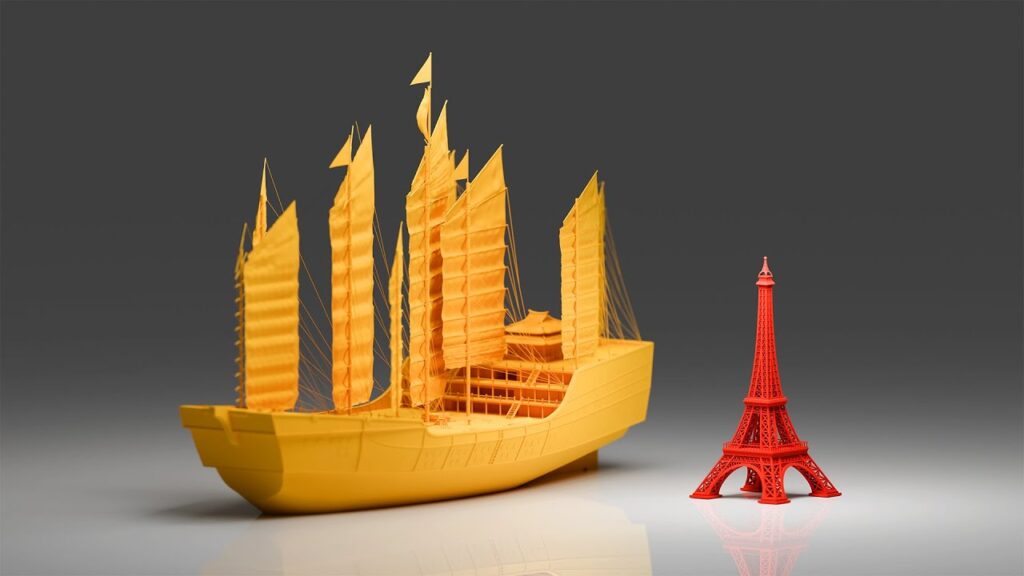
Even if the claim that he beat Christopher Columbus to the Americas can’t be supported, he really did get around, and in seriously impressive ships at that. In the Hoog video above, you can see Zheng He’s story told with retro 3D video-game graphics suitable to convey the kind of adventure his life became. Yet it could hardly have begun more humbly: born into a Muslim family in the southern, Mongol-controlled Yunnan province, he was captured by the Ming military and castrated in adolescence.
Harsh though that sounds, it made him able to accrue a kind of power that could never have been his otherwise. To lead this “moving empire” with its staff of 27,000 — many of them eunuchs — he knew no one more reliable than his old friend Zheng He. This fleet’s expeditions maintained sufficient hegemony to ensure a period of regional stability some call the Pax Ming.
At the same time, the civil service grew ever more resentful of the privileged eunuch class, and a lightning strike on the Forbidden City in 1421 was taken as a sign that the time had come to criticize their leadership. It would seem that Zhu Gaochi, the Yongle Emperor’s son, took this criticism to heart. When he took power as the Hongxi Emperor after his father died while Zheng He was at sea, he put an end to the costly naval expeditions that could, in theory, one day have reached the New World.
Questions about why China’s age of maritime exploration had to end have more recently been joined by others about whether such a vast fleet really could have sailed, and for that matter, whether the enormous treasure ships could even have been built in the first place. China may have done away with the eunuch system more than a century ago, but there’s no doubt that its current leadership recognizes the importance of sea power — or that it has its eyes on the heavens. How Ancient Greek Warships Worked: The Engineering of the Trireme Explained in 3D Animation The 500-Year-Old Chinese “Bagel” That Helped Win a War How a 16th-Century Explorer’s Sailing Ship Worked: An Animated Video Takes You on a Comprehensive Tour Watch the First Chinese Animated Feature Film, Princess Iron Fan, Made Under the Strains of WWII (1941) Based in Seoul, Colin Marshall writes and broadcasts on cities, language, and culture.
Extract — continue reading at the source.