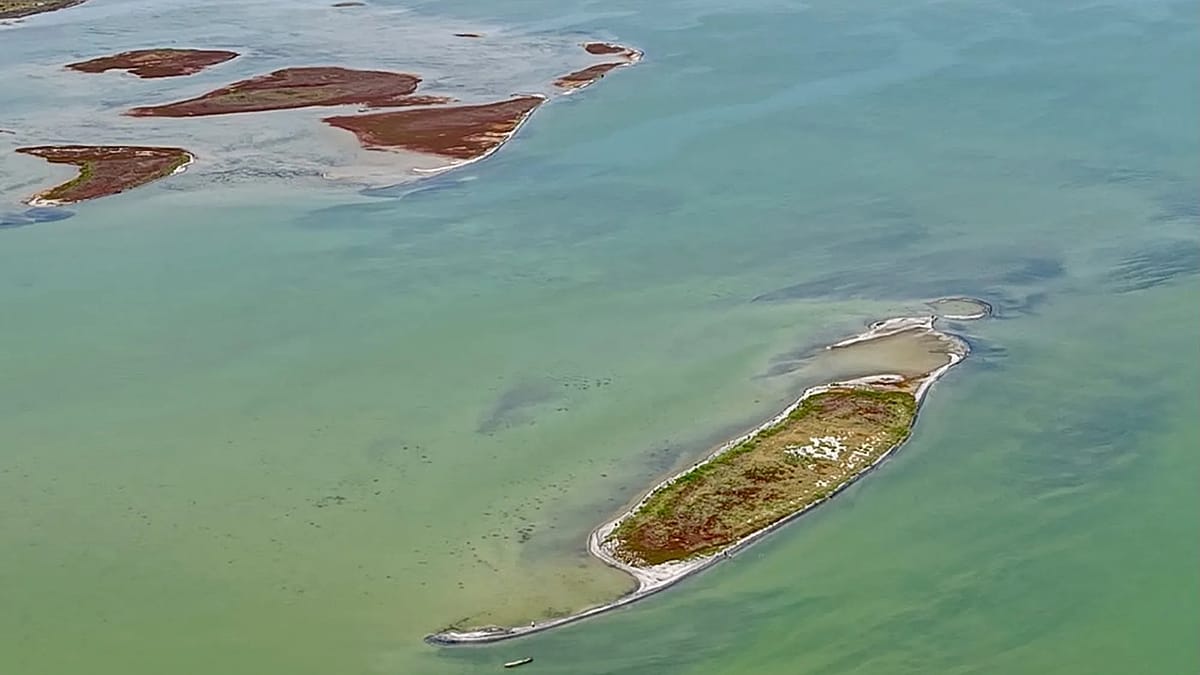
The Caspian Sea is the largest inland body of water on Earth, but for years it has been shrinking. The northern and north-eastern parts along Kazakhstan's coast form the shallowest sector of the Caspian Sea, typically ranging between just three and six metres. But as water levels continue to fall, following decades of climate change and human activity, environmentalists are discovering clusters of under-water islands.
The latest was spotted days ago near Kulaly Island during a recent aerial survey. Volunteer and environmental activist Daniyar Akimzhanov was part of the group that reported the discovery. He says that the newly emerged island is relatively small, but it is far from an isolated case.
In fact, over the past four to five years, Akimzhanov says he has documented several new islands in this part of the Caspian Sea. There are much bigger new islands,” he explains. Some stretch around one kilometre in length and 200 to 300 metres in width and wildlife has already begun reaching the newly exposed land.
Akimzhanov says he personally spotted a wild boar on one of the islands, while wolves also make their way there across the ice. The newly emerged islands usually do not get names, he says. The Kazakh Research Institute of the Caspian Sea, which began work in September 2025 after being established on the instructions of President Kassym-Jomart Tokayev, says more areas of land are likely to emerge.
However, not all of them will become permanent islands. The emergence of new islands is one of the most visible signs of a much broader transformation: the Caspian Sea is retreating. The Caspian Sea is the world's largest landlocked body of water.
It is bordered by five countries: Kazakhstan, Russia, Azerbaijan, Iran and Turkmenistan. More than 80 per cent of its river inflow comes from Russia’s Volga River. Sifan Koriche, a hydroclimate scientist at the University of Alabama who has published several studies on the Caspian Sea, explains its water balance in simple terms.
Extract — continue reading at the source.