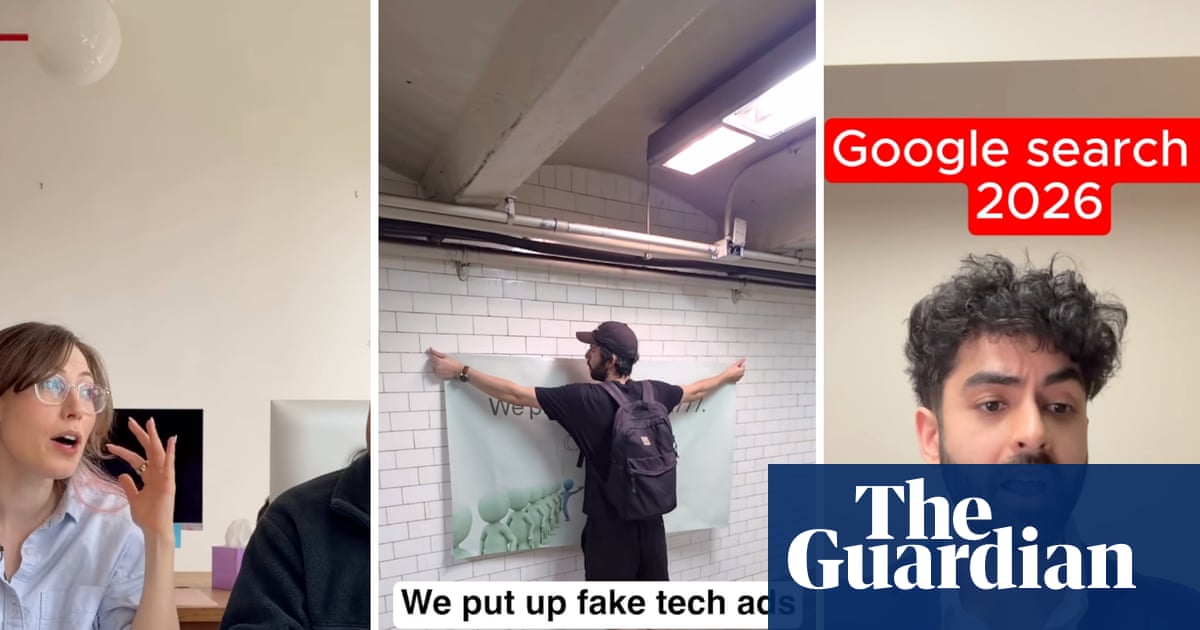
Another advises viewers that Ziplink is now known as Froggle. The posters are real, but the companies aren’t; the CEO and datacenter scenarios are social media sketches (though the “great companies” quote is a genuine piece of wisdom from Sam Altman). It’s all part of a recent wave of comedy inspired – but absolutely not generated – by AI.
The comedy extends across all forms of media: social videos, standup, songs, humor columns, comic strips and art installations. It takes aim at companies’ attempts to make AI ubiquitous, the dangers of believing its every word, its threats to society and the environment. It effectively punctures tech CEOs’ relentless narrative: that artificial intelligence represents humanity peaking; that it is inevitable and all-powerful; that we have no idea where it’s going and it could kill us all, but for some reason it is absolutely essential to pursue.
It’s no surprise that a topic as pervasive as AI in 2026 would end up in comedians’ crosshairs. A March Gallup poll found 79% of Americans believe AI will reduce jobs. In a CNN poll this week, 81% of respondents said they were more concerned than excited about how the technology could “fundamentally change our way of life”.
Only 11% of Americans would support the building of a datacenter locally, according to UMass Amherst. Meanwhile, a handful of impossibly wealthy weirdos wander between podcasts and conference stages boasting about their plans to fundamentally alter what it means to be human. One way to expose the absurdity of the AI companies’ story is by exposing the flaws in their products.
Ty Eveland, for instance, trolls AI doctors and HR professionals – the video bots you might awkwardly encounter at a virtual doctor’s appointment or job interview. Asked about marketing, he tells one bot interviewer he takes “everything with a grain of salt and maybe a little bit of pepper”. The bot, portrayed as a generically handsome blond man, responds earnestly: “When you say you take things with a grain of salt and pepper, what does that actually mean for a brand’s social media strategy?” If bots are approaching superintelligence, this one has clearly been left behind.
Other comedians parody the user experience: the comedian Aya Huseen, repeatedly popping out from behind a door, personifies tech companies’ desperate attempts to get users hooked on new AI features: “You sure you don’t want to try it with AI?” “This would be so much funner with AI.” “Just try generating it with AI.” The comedian Tom Nestor imagines “how people who love AI think we see them,” telling a friend on the phone: “Do you know what I also really like? It’s not so good now but in years to come it’ll get so good that it’ll just completely alter people’s grasp of reality.” In the Atlantic, the humorist Alexandra Petri recounts a dream in which everything in her life has pivoted to AI, from children’s books – Goldilocks and the 4.5 Bears – to her cereal, which features “subtle changes in the recipe, such as the nuts now being the hard, metal kind”. Pro-human comedians have also taken aim at AI’s artistic pretensions.
Extract — continue reading at the source.