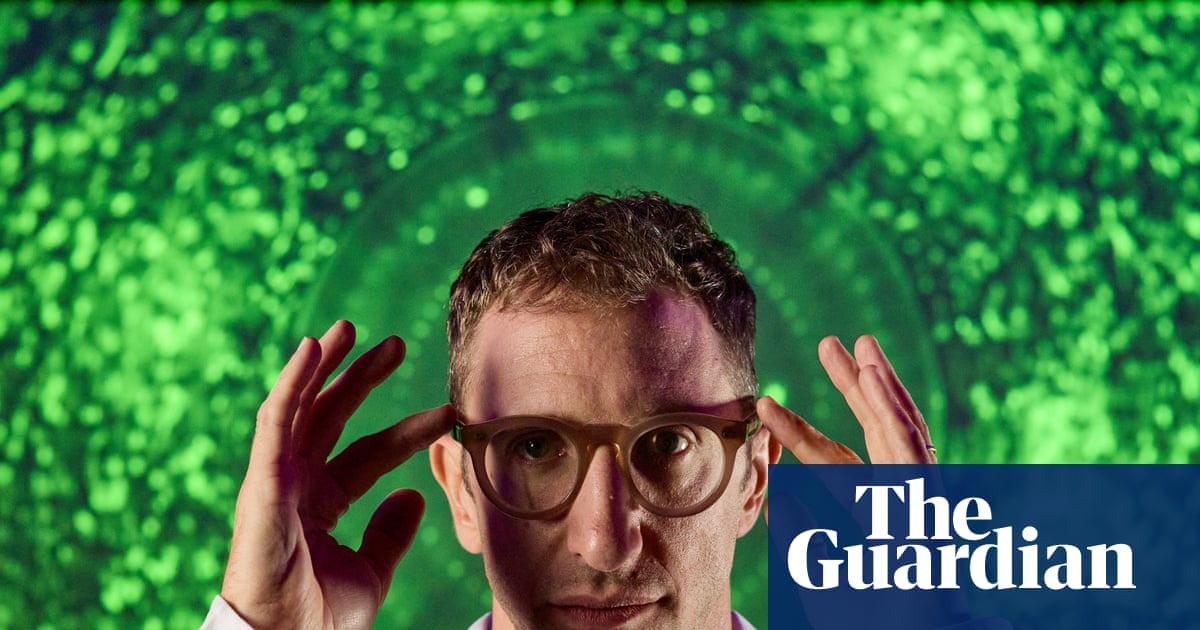
He is an artist who, in 2019, jointly won the Turner prize; and one of his works is, for my money, among the most striking on show at this year’s Venice Biennale. But he is also the director of a young NGO, founded in 2023, called Earshot, which investigates human rights abuses using sound evidence. In less euphemistic language, that means, on occasion, investigating horrific killings.
He and his team might analyse the direction and position of bullets Israeli soldiers have fired at emergency workers in Gaza, or build evidence that a sonic weapon was likely used to disperse a mass silent vigil in Belgrade. The foundational work he did in this field was a project with the London-based research agency Forensic Architecture for Amnesty International. Back in 2016, he interviewed rare survivors of the unimaginably barbaric conditions in Syria’s Sednaya prison.
There was a paradox at play in this murderous place – prisoners were held in complete darkness, and enforced silence, killed for making any sound. Listening was both the inmates’ only source of information, and a tool for survival and resistance. Their acute sonic memories of screams of distress and pain; keys turning in locks; bread being slapped down outside their cells; even of lice being snapped – helped Abu Hamdan and his colleagues build a picture of the prison architecture and its conditions, nearly a decade before it was opened to the light after the fall of the bloody Assad regime.
In fact, these identities of Abu Hamdan’s – artist and audio investigator – are not separate. Instead, they are interlocking, the art forming a sensory, aesthetic and emotional expression of the hard-nosed research. The Sednaya project profoundly influenced Abu Hamdan as an artist.
The cases Earshot now take on result in formal written reports – and some of them also in artworks. Let’s unfold it and reflect on what we did and what it meant.’ It’s a duality and it helps us sustain our ears. To keep us listening in as sharp a way as possible.” I imagine Earshot’s new offices – part of a complex of artists’ studios in south London – as something out of film noir, with the Lebanese-British Abu Hamdan as the resident private eye (or “private ear”, as he calls himself).
Somehow, there should be a glass door with his name engraved on it, a fug of smoke inside. Instead he and his colleagues, mostly graduates from architecture schools, are based in a small open-plan office of impeccable bright-white tidiness, the only hint of the particular nature of the work a tiny silver pendant of an ear around Abu Hamdan’s neck. But mysterious things are happening on neighbouring computer screens as we talk.
Extract — continue reading at the source.

.jpg)