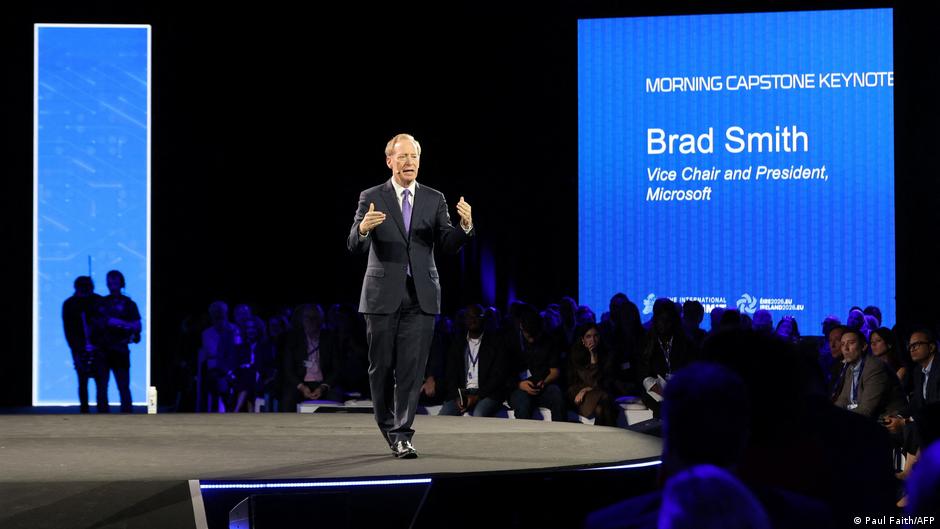
Step-dancers spun across the circular stage in the middle of a dark hall, entrancing an audience of policymakers and tech bosses. Not simply another bureaucratic conference, the International AI Summit, hosted in Dublin this week, aspired to something more spectacular — a grand announcement that Europe is ready for its artificial intelligence (AI) revolution. Among the more than 1,500 expected guests were Google DeepMind co-founder and chair Demis Hassabis and Microsoft president Brad Smith, in addition to high-ranking European Union and Irish officials.
The event was a key part of Ireland's term as president of the EU Council, but a lack of critical voices to counterbalance the AI enthusiasm on display has drawn accusations of tech boosterism. The summit was "almost like a party political broadcast on behalf of AI," Barry O'Sullivan, an AI professor at University College Cork, told DW. The overarching theme was how to use AI to get Europe's sluggish economy moving, boost innovation and catch up with the US and China.
On panels packed with senior executives, the potential benefits were made clear: detecting early signs of cancer, improving warnings of extreme weather, and optimising power distribution to save energy. Turning those promises into reliable services, however, still requires testing and validation. Ireland's interest in these issues doesn't come purely from goodwill towards its fellow EU member states.
The country hosts the European operations of several of the world's largest technology companies, and relies heavily on the taxation of multinational firms. Foreign-owned multinationals paid €28.8 billion in corporation tax in 2025, accounting for 87% of the total, excluding exceptional Apple tax proceeds. That includes pharmaceuticals and other sectors, not just technology.
This means Dublin has a clear interest in shaping European rules while keeping investors on board. But Europe's financial firepower remains far behind America's: Private AI investment reached $286 billion (about €253 billion) in the US in 2025, compared with $21 billion (€18.6 billion) in Europe, according to Stanford University's AI Index. But does Europe even need to compete on the same terms?
O'Sullivan thinks it should focus on its own strengths, including industrial robotics and specialised applications: "We have a unique kind of AI opportunity in Europe, and that's what we should back." Using foreign models could help European businesses move faster. But it also leaves them dependent on suppliers elsewhere, which can change prices, restrict access and decide which capabilities to release. EU representatives at the summit were quick to underline that rules were now in place to reap AI's benefits while mitigating its risks.
Extract — continue reading at the source.