In the early first century, a mighty king ruled the Atrebates tribe located in southern Britain: King Verica, son of Commius. As a client king of the Roman Empire, King Verica had a powerful ally in Emperor Claudius, who, in turn, enjoyed a foothold on the island. So when King Verica was exiled around 40 CE, it offered a pretext for Claudius to invade Britain (according to writings by the Roman historian Cassius Dio), sparking a campaign that would ultimately lead to the Roman conquest of Britain.
There’s just one problem with Dio’s story. King Verica wasn’t the son of Commius, she was the daughter of Commius—Verica was a female king. Or at least that’s the case archaeologist Miles Russell of Bournemouth University makes in a newly published book Caratacus: Great King of Britain.
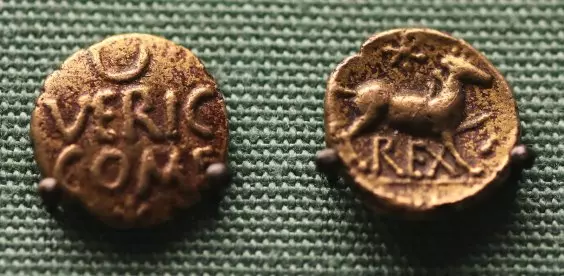
Read more: “Mass Grave of Women and Children Shows Brutality of Iron Age Culture” “Verica is assumed to have been male because of the patriarchal mindset of 19th century, classical historians,” Russell explained in a statement. Verica ends in an “a” like the names of other indisputably female figures at the time (including Boudica, who led a failed rebellion against conquering Roman forces later on). The gender confusion centers, in part, around the word “rex” imprinted on coinage bearing Verica’s name which were found littered around Hampshire and Sussex where her tribe lived.
Russell says Roman leaders tolerated and recognized female kings, and the term “rex” was a gender-neutral appellation. And the coins contain more clues as well. The backs of the currency are stamped with the letters “COMF,” which historians initially read as an abbreviation of Commios filius, “son of Commios.” Russell points out they could just as easily be an abbreviation of Commios filia, “daughter of Commios.” Finally, the fronts of the coins depict a slender, bare-breasted woman—a pretty big sign Verica was female.
Of course, the revelation that Verica was a woman isn’t just a minor bit of historical trivia, it also provides important context for understanding of Emperor Claudius and the conquest of Britain. Claudius, a limping stutterer who suffered sickness early in life, was mocked by Cassius Dio and other writers as a weak leader who was easily swayed by wives. Verica being a woman obviously fits neatly with this reputation.
Subscribe to our free newsletter.
Extract — continue reading at the source.