A protein best known for helping cells and tissues stay connected has another unexpected role. Researchers have found that it also helps epithelial cells, which form continuous sealed layers throughout the body, engulf nearby dead cells. The discovery could have implications for chronic inflammation.
Debris from dying cells is a major contributor to inflammatory responses, so understanding how tissues remove that material may reveal new clues about what happens when the cleanup process fails. The study, published in Nature Communications, focuses on the E-cadherin complex. This molecular system includes E-cadherin along with three additional proteins.
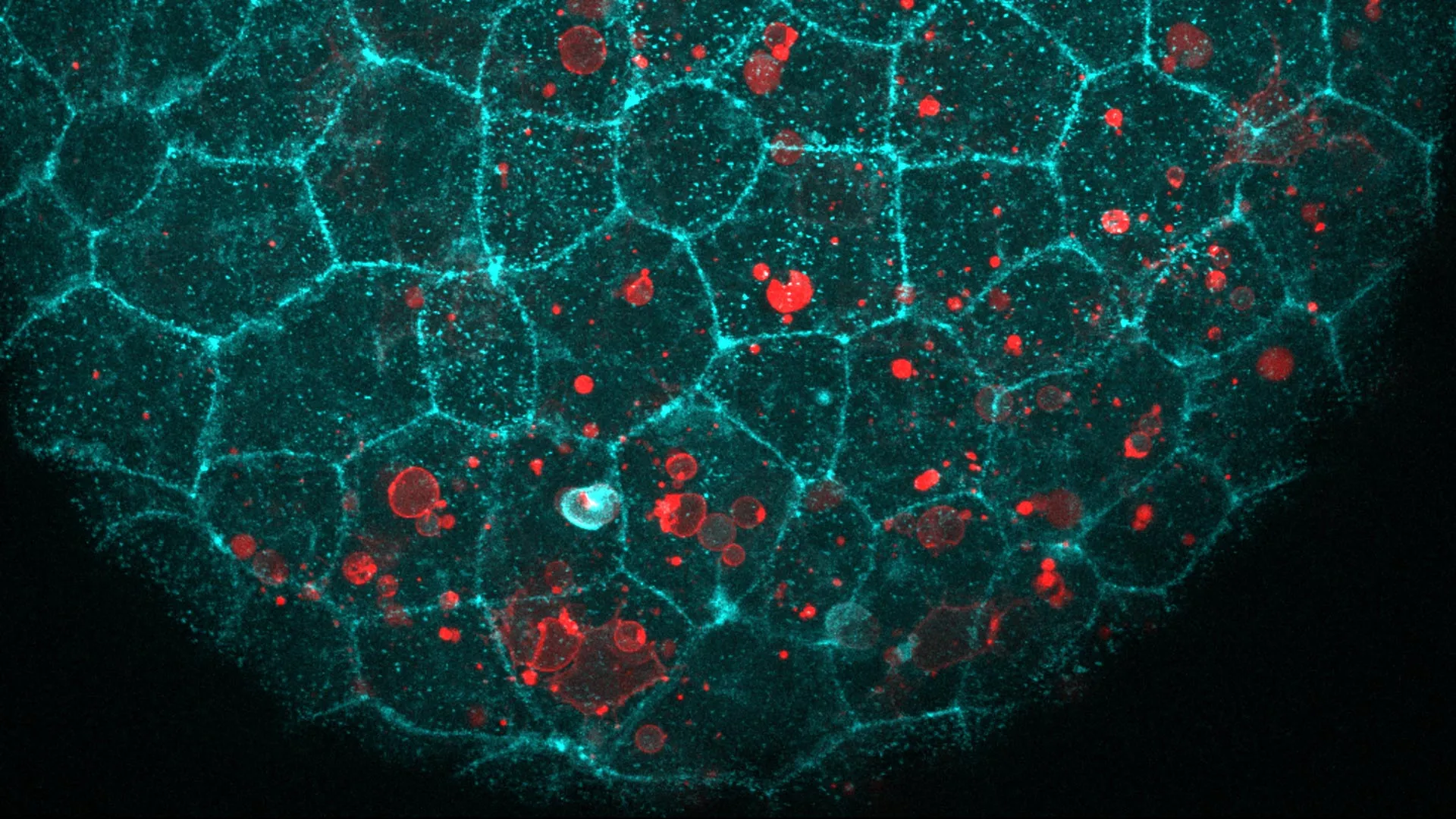
Together, they connect epithelial cells lining areas such as the skin, gut and airways, giving tissues the structural strength they need to remain intact. In these tissues, each cell connects to E-cadherin molecules on neighboring cells. A team led by Verena Ruprecht examined epithelial tissues in living zebrafish and mouse embryos.
They found that the same molecular machinery also gathers at the exact location where a dying cell comes into contact with the tissue. The researchers wanted to know whether E-cadherin and its partners were attaching to the dying cell in the same way they normally attach neighboring epithelial cells. To test that possibility, they carried out two experiments.
First, they presented the tissue with dying cells that had been stripped of E-cadherin. The epithelial tissue removed those cells just as effectively as it removed normal dying cells. Next, the team introduced fat droplets that contained no protein at all but carried a signal normally displayed on the surface of dying cells.
The epithelial cells engulfed those droplets as well. "We were intrigued to find out that epithelial cells repurpose their molecular adhesion machinery -- the 'glue' that normally holds them together -- to engulf dying cells," says ICREA Research Professor Verena Ruprecht, senior author of the study. How Cells Eat Without Breaking the Barrier Engulfing something roughly the size of another cell presents a difficult mechanical problem.
Extract — continue reading at the source.