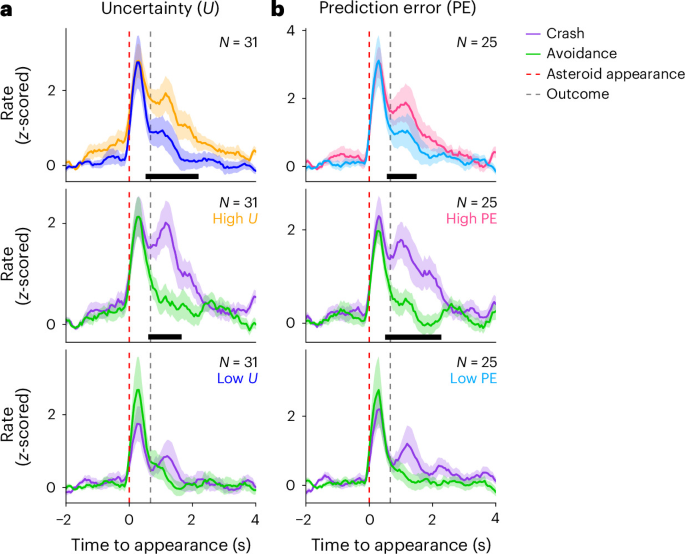
Single-neuron recordings provide direct evidence that the human claustrum tracks uncertainty and prediction errors during adaptive behavior. Its responses differed from those in the anterior cingulate cortex, which raises the possibility that these regions make distinct contributions to updating beliefs and guiding behavior in ever-changing environments. This is a preview of subscription content, access via your institution Access Nature and 54 other Nature Portfolio journals Get Nature+, our best-value online-access subscription Receive 12 print issues and online access Prices may be subject to local taxes which are calculated during checkout Jackson, J., Smith, J.
The anatomy and physiology of claustrum-cortex interactions. Neurosci. 43, 231–247 (2020). This review synthesizes evidence for the claustrum’s extensive cortical connectivity and circuit physiology, which provided the anatomical foundation for investigating its computational role in human cognition.
Anterior cingulate cortex input to the claustrum is required for top-down action control. Cell Reports 22, 84–95 (2018). This study demonstrates that anterior cingulate cortex input to the claustrum is required for top-down action control, which provided a mechanistic precedent for comparing claustrum and anterior cingulate cortex activity in our task.
Article CAS PubMed PubMed Central Google Scholar Crick, F. What is the function of the claustrum? Sci. 360, 1271–1279 (2005).
This seminal paper proposes that the claustrum coordinates activity across distributed cortical systems, which motivated our question of what computations individual human claustrum neurons encode. Article PubMed PubMed Central Google Scholar Wise, T. & Dolan, R. Associations between aversive learning processes and transdiagnostic psychiatric symptoms in a general population sample.
This study introduces the aversive-learning paradigm adapted here and provides the computational framework for estimating trial-by-trial prediction error and uncertainty. Precision and the Bayesian brain. Biol. 31, R1026–R1032 (2021).
Extract — continue reading at the source.


