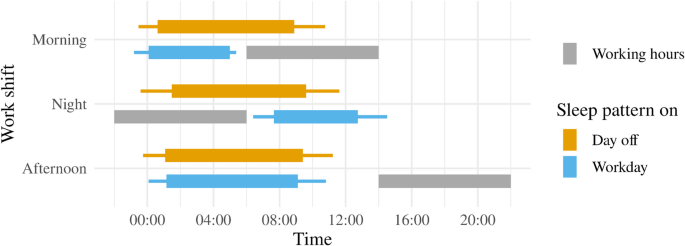
Shift work disrupts sleep patterns and is associated with adverse health outcomes, yet the role of chronotype in shaping shift workers’ sleep behavior remains underexplored. We conducted a field study of 85 shift workers at an industrial plant in Uruguay operating under a slow, counterclockwise three-shift rotation system. We assessed sleep timing, duration, napping, and chronotype using an abbreviated Munich Chronotype Questionnaire for shift workers.
Night and morning shifts produced the largest shifts in sleep timing and the greatest restriction in sleep duration. Workday sleep was shorter, and napping was more frequent, during morning and night shifts than during the afternoon shift and days off. Participants were predominantly evening-oriented.
Chronotype strongly modulated sleep patterns: evening-oriented workers slept longer during night and afternoon shifts and days off, and napped longer on morning workdays. A 1-hour delay in chronotype was associated with 6–25 min of additional sleep. Weekly average 24-hour sleep duration remained below recommended levels during morning and night shifts (~ 7 h) but exceeded 8 h during the afternoon shift, with longer sleep among later chronotypes.
These findings identify chronotype as a key factor shaping sleep under shift work and support its consideration in shift scheduling to improve sleep health and reduce the adverse effects of shift work. Many health inequalities among workers are associated with differences in work organization1,2, including the temporal structure of work3. A substantial proportion of the global workforce operates under non-standard schedules (e.g., between 19:00 and 06:00), often involving fixed night shifts or rotating shifts, particularly in industries requiring continuous operation.
It is estimated that 10–20% of workers worldwide engage in shift work, with higher prevalence in certain regions4. Despite these schedules, most shift workers remain entrained to the natural light-dark cycle5, resulting in misalignment between endogenous circadian rhythms and externally imposed work times. However, it remains unclear to what extent the negative health effects of shift work are mediated by circadian and social misalignment, as well as disturbed sleep6,7,8,9.
Disturbed sleep is prevalent among shift workers, who report difficulties initiating and maintaining sleep, increased sleepiness, and shorter sleep duration than daytime workers10, particularly during night and early morning shifts11,12, which require substantial adjustments in sleep timing. Disturbed sleep has been linked to adverse health consequences and to impaired performance and safety at work6,7,8,9,13,14,15. Insufficient and poor sleep has also been proposed as both a marker and a potential contributor to reduced tolerance to shift work16,17.
Extract — continue reading at the source.


