The classic jump-scare or eerie monster story will do the trick. But pondering the depths of space and the extents of time, or the existential risks inherent in both technology and nature, can just as easily leave you reeling. So too can an idea that inverts your assumptions about the world and makes you question the foundations of your own reality.
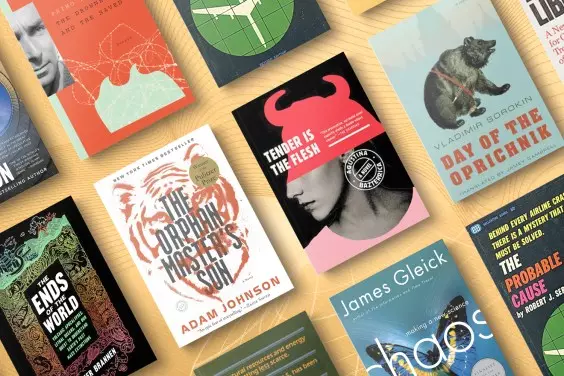
The unlit corners of human knowledge can feel like their own kind of lurking monster. This Halloween, we offer you a dozen books recommended to us by some of our favorite scientific and artistic luminaries, each of which may fill you with both wonder and terror. While you might want to proceed with caution, our scientists and artists warn us, you will find an enriching light at the end of these 12 literary tunnels.
The Ministry for the Future by Kim Stanley Robinon Katie Mack, theoretical astrophysicist, chair in cosmology and science communication at the Perimeter Institute, author of The End of Everything (Astrophysically Speaking): “It’s a climate change story, but specifically one about how we might, possibly, maybe, find ways to cope and survive in the future. The opening chapter, a vivid description of a deadly, extreme heat event, is horrifying and haunting. I first read it shortly after its publication in 2020, and while I was at the time disturbed by the descriptions of climate disasters, it has become much more unsettling in the years since, with extreme weather events becoming much more frequent, and political shifts making positive change look harder to achieve.
It’s a book I find hopeful and unsettling in equal measure, and I’m both eager and terrified to see how it will read ten or twenty years in the future.” The Ends of the World: Volcanic Apocalypses, Lethal Oceans, and Our Quest to Understand Earth's Past Mass Extinctions by Peter Brannen John D. Boswell, filmmaker and composer, whose projects include Symphony of Science, which sets the words of Carl Sagan, Richard Feynman, and other great scientists to music: “No other book has done more to illuminate the ancient past than this one, and in the most disturbing way. It paints a picture of all the major extinction events in Earth’s history, from the mysterious Ordovician extinction to the demise of the dinosaurs, in excruciating detail that feels lifted from a horror film.
But the most alarming passages detail just how quickly the Earth can upend itself—systems that appear stable for millions of years can suddenly flip and cause climate chaos, with unpredictable ripple effects through our planet’s ecosystems. I’ve never been more captivated by a book, which manages to excite me and terrify me in equal amounts.” The School of Night by Karl Ove Knausgaard David Krakauer, President and William H. Miller Professor of Complex Systems at the Santa Fe Institute: “The novel starts with a claustrophobic and thwarted childhood in Norway, followed by angry disregard in an art school in London, and then an uncanny Faustian pact is made.
The protagonists’ success is accelerated until the inevitable decline into hell. This is all achieved in dismal London streets and isolated farmhouses on rainy archipelagos. As in Christopher Marlowe's original Doctor Faustus, the question this novel asks is, ‘How much is anyone prepared to pay for success and fame?’ The answer is unsettling.” Chaos: Making a New Science by James Gleick Robert Sapolsky, neuroscientist, primatologist, and author most recently of Determined: A Science of Life Without Free Will: “This book shows us that the world can be utterly deterministic yet formally unpredictable.
Extract — continue reading at the source.