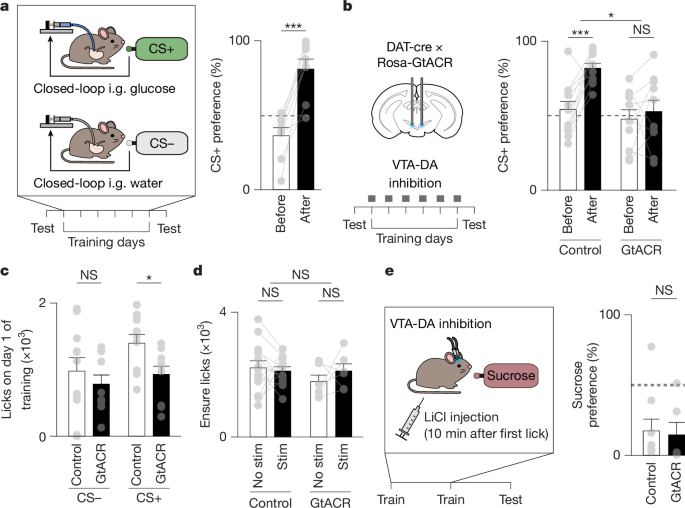
Animals learn about the external world in part through interoceptive signals1,2. For example, the nutrient content of food is first estimated in the mouth, in the form of flavour, and then it is measured again through slower signals from the gut. How these signals from the mouth and gut are integrated to drive learning is unclear.
Here we identify a dopamine (DA) pathway that enables learning about the nutrient content of food. We show that DA neurons in the ventral tegmental area are necessary for associating nutrients with flavours, and that post-ingestive nutrients trigger DA release selectively in a small region of the anterior basolateral amygdala (BLA) but not in canonical DA targets in striatum. This nutrient-triggered DA release occurs preferentially in the left BLA in mice, and this same structure is preferentially activated by post-ingestive nutrients in humans.
We identify the gut sensors that are responsible for nutrient-triggered DA release; show that they activate BLA-projecting DA neurons defined by expression of cholecystokinin; and demonstrate that stimulation of DA axon terminals in the anterior BLA drives flavour–nutrient learning but not other aspects of feeding behaviour. Two-photon imaging of neurons in the left anterior BLA reveals that they integrate gustatory and post-ingestive cues, and silencing these neurons prevents flavour–nutrient learning. These findings establish a neural basis for how animals learn about the nutrient content of their food.
This is a preview of subscription content, access via your institution Access Nature and 54 other Nature Portfolio journals Get Nature+, our best-value online-access subscription Receive 51 print issues and online access Prices may be subject to local taxes which are calculated during checkout The data used to generate the main findings of this study have been publicly deposited at Dryad74 (https://doi.org/10.5061/dryad.h9w0vt4x2). No custom software or original algorithms were developed for use in this study. Any of the findings can be replicated using established software and the deposited data.
Learned controls of ingestive behaviour. Appetite 29, 153–158 (1997). Conditioned food preferences.
In Psychology of Learning and Motivation (ed. L.) Vol. 28, 1–33 (Academic, 1992). Intragastric reinforcement effect.
Extract — continue reading at the source.


