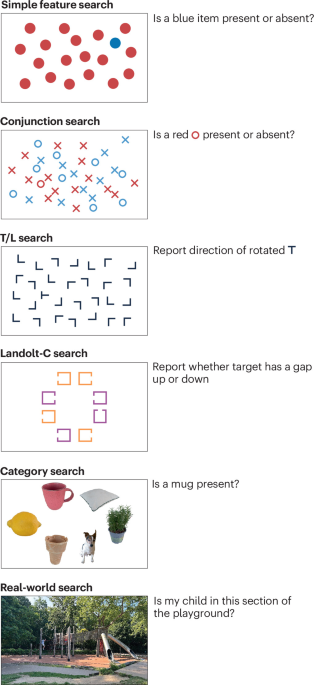
In everyday life, people often search for items, such as a pen on a cluttered desk. To perform a visual search task, top-down control guides attention towards goal-related target objects. The modal theoretical view of top-down control in the field suggests that humans hold a veridical representation of the desired target in working memory as the attentional template, and use this template to guide attention towards potential targets.
In this Review, we synthesize evidence that violates these principles. First, we describe the modal theoretical view of visual search. Next, we discuss evidence that top-down control is frequently driven by long-term instead of working memory.
Then we discuss evidence that guidance can be shifted away from a veridical target representation if doing so leads to more efficient search. Next, we discuss evidence that attention can be guided away from distractors, in addition to being guided towards targets. Finally, we discuss the role of prior experience in attentional guidance.
In sum, the current state of the field suggests that attentional guidance is flexible, adaptive on the basis of experience, and driven by a coordination of multiple internal mechanisms including working memory, long-term memory, statistical learning and selection history to direct attention efficiently. This evidence suggests the need for theoretical models that incorporate the multiple factors that guide attention. This is a preview of subscription content, access via your institution Receive 12 digital issues and online access to articles Prices may be subject to local taxes which are calculated during checkout Wolfe, J.
What attributes guide the deployment of visual attention and how do they do it? Neurosci. 5, 495–501 (2004). Visual search: how do we find what we are looking for?
Article PubMed PubMed Central Google Scholar Woodman, G. Where do we store the memory representations that guide attention? Working memory and attention — a conceptual analysis and review.
Extract — continue reading at the source.