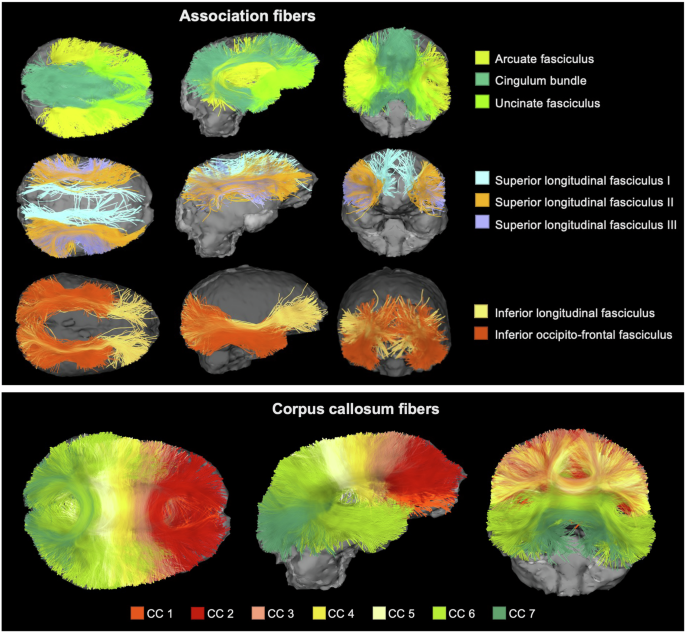
Childhood maltreatment (CM) is a risk factor for adult post-traumatic symptoms and white matter (WM) alterations. It remains unknown how WM microstructure is affected alongside two common military conditions, post-traumatic stress disorder (PTSD) and mild traumatic brain injury (mTBI). Data from 299 participants (53% male, 35.69 ± 12.23 years of age) of the Injury and Traumatic Stress (INTRuST) clinical consortium was analyzed.
The study included 56 individuals with PTSD (41 with comorbid mTBI), 107 with mTBI, and 136 controls (no PTSD and/or mTBI). Diffusion parameters (mean, axial, and radial diffusivity, MD, AD, RD; fractional anisotropy, FA) in major WM tracts were extracted from diffusion MRI. CM was assessed using the Childhood Trauma Questionnaire (CTQ).
Multiple regression models examined associations between CM severity and WM diffusion. Moderation analyses assessed the effect of PTSD and/or mTBI on these associations. Mediation analyses examined how WM diffusion affects the associations between CM and both PTSD and post-concussive symptom severity.
Greater CM severity was associated with lower MD and AD, independent of PTSD and/or mTBI. WM diffusion, particularly in the corpus callosum and the superior longitudinal fasciculus, mediated the associations between CM severity and both PTSD (MD bab = 0.022, AD bab = 0.019-0.034) and post-concussive symptoms (MD bab = 0.028-0.040, AD bab = 0.032-0.047). Findings suggest that WM alterations are more strongly associated with CM itself than with either PTSD and/or mTBI.
Mediating effects in regions critical for sensory integration highlight the role of WM microstructure as a neurobiological pathway through which CM might predispose to post-traumatic symptoms. Childhood maltreatment (CM) is widely recognized as a major risk factor for adult mental health problems such as depression, anxiety, substance use disorder, and post-traumatic stress disorder [1]. Notably, military service members report higher CM experience rates, with military personnel being twice as likely to report having experienced physical or sexual abuse in their childhood [2].
While the relationship between CM and adult mental health problems seems evident, the underlying pathophysiological mechanisms driving this connection remain largely unknown. Understanding these neural pathways is crucial for developing targeted interventions and preventive measures. This is particularly important for the vulnerable population of military personnel who may also be exposed to additional trauma from combat and war zone-related experiences [3, 4].
Extract — continue reading at the source.