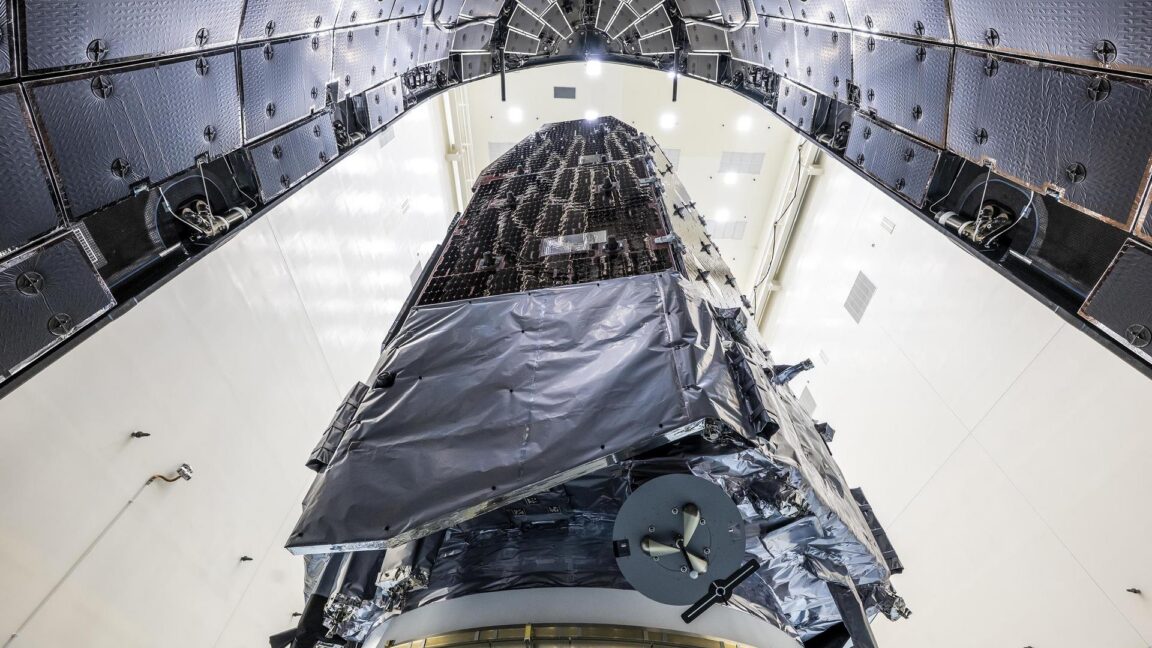
NASA’s Nancy Grace Roman Space Telescope is gliding toward its distant observation post on a pinpoint trajectory so precise that engineers estimate the spacecraft’s fuel load will last twice as long as their initial expectations, the space agency confirmed Monday. The $4.3 billion observatory’s designers originally planned to load enough propellant into Roman’s four fuel tanks for a minimum lifetime of five years, plus a potential five-year mission extension. That was a conservative estimate.
NASA officials knew an on-target launch and perfect execution of the observatory’s first post-launch course correction maneuver would leave Roman with a hearty fuel reserve. The James Webb Space Telescope received a similar lifetime boost after a picture-perfect launch on a European Ariane 5 rocket in 2021. The Roman telescope launched August 30 from NASA’s Kennedy Space Center in Florida aboard a SpaceX Falcon Heavy rocket, kicking off a mission to widen our view of the Universe.
Roman’s telescope and scientific instruments will provide astronomers with images of the sky at the same resolution as NASA’s Hubble Space Telescope, but with 100 times the field of view. It would take Hubble a century to observe what Roman will see in a month. Astronomers hope Roman’s broad vision will reveal insights into the largest structures in the Universe.
Roman’s Wide Field Instrument, fitted with 18 near-infrared detectors, will produce images equivalent to those of a 300-megapixel camera. Its wide viewing area will allow Roman to map galactic clusters, along with the filaments of matter and dark matter that string through the cosmos. Mapping so much of the sky could help astronomers study the nature of dark energy, scientists’ name for the elusive force driving the acceleration of the Universe.
Extract — continue reading at the source.