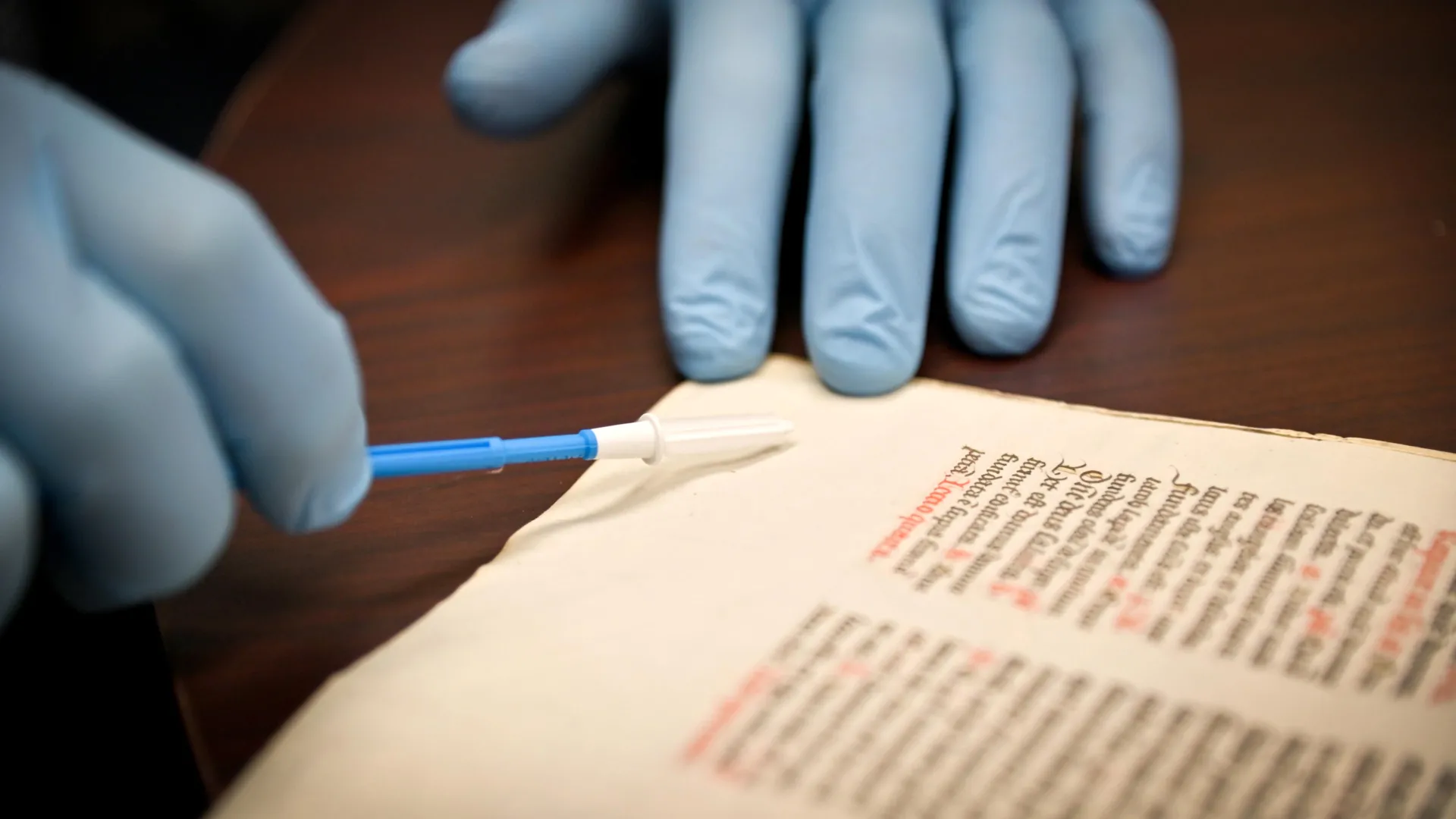
Scientists have developed a way to recover cellular material from historic parchment manuscripts without damaging the documents. The technique makes it possible to analyze genetic information preserved in parchment and could reveal new details about trade, farming, and other aspects of life stretching back roughly 1,300 years. Parchment is made from animal skin and was used for thousands of years across Europe, the Middle East, and parts of Africa.
It served as the material for many kinds of written records, including legal documents and maps. Because the skins retain biological material, parchment can preserve genetic clues alongside the words written on its surface. "Because they are made from animal skins, it is often possible to extract genetic information from parchments," says Tim Stinson, corresponding author of a paper on this research and an associate professor of English at North Carolina State University.
"That genetic information, in turn, offers us a window into the past, answering questions about things such as when and where a manuscript was made." The genetic information could reveal much more than the origins of individual documents. Since parchment was widely used for centuries, DNA recovered from it may help researchers investigate how domesticated animals changed over time, how different breeds emerged, and what diseases affected livestock. "Because parchments have been in use for so long, and often record detailed historical information, the genetic information they contain can also shed light on the evolution of domesticated farm species, how breeds developed over time, livestock diseases and so on," says Matthew Breen, co-author of the paper and the Oscar J.
Fletcher Distinguished Professor of Comparative Oncology Genetics in NC State's College of Veterinary Medicine. Until now, one major obstacle has been access. Libraries, museums, and other institutions have understandable concerns about allowing researchers to take samples from rare and culturally important manuscripts if doing so might cause permanent damage.
"This paper is particularly important because one of the biggest challenges for this emerging field of genetic analysis has been gaining access to historic parchments, due to concerns that collecting samples would damage these culturally significant artifacts," says Stinson. "Our work shows that we can collect samples without harming the parchments, which is a big step forward." To demonstrate the approach, the researchers collected cellular samples from 91 manuscripts housed in the Rubenstein Library at Duke University. The documents came from locations ranging from England to Ethiopia and were produced between the late eighth and early 20th centuries.
The sampling method is surprisingly simple. Researchers gently rub the parchment with a dry cytology brush, the same type of brush used for Pap smears. The brush picks up cellular material while leaving the historic document intact.
Extract — continue reading at the source.


