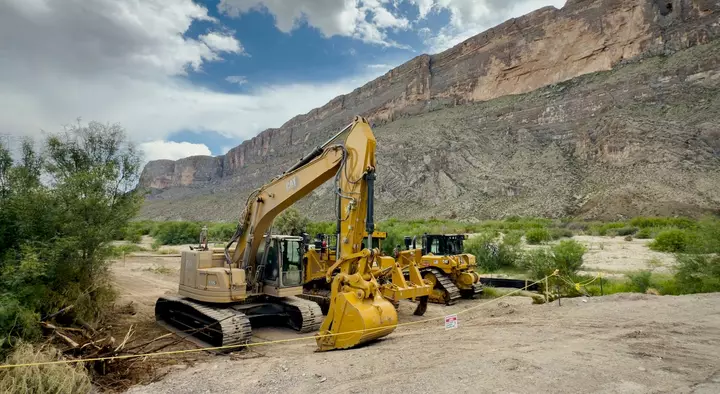
An excavator and bulldozer sit near Santa Elena Canyon in Big Bend National Park, Texas, on August 13, 2026. The Trump administration is asking the Supreme Court to allow border construction to resume after a federal judge halted the work. ( ight over border construction in Big Bend National Park has reached the U.S. Supreme Court, after the Trump administration asked justices to override a federal judge who had ordered work to halt.
On October 29, plaintiffs in an ongoing lawsuit over the border construction, including the Center for Biological Diversity, Friends of the Ruidosa Church, and a local Rio Grande river guide, urged the justices to keep construction on hold. They warned in a 50-page filing that roads and barriers could permanently scar the fragile Chihuahuan Desert ecosystem surrounding Big Bend National Park, threaten river access and local livelihoods, and damage historic sites. The document cited earlier testimony from local residents, environmental researchers, and other officials who oppose the construction.
I think it will be a tour of the military-industrial complex, not a tour of the wilderness.” The Supreme Court’s decision could determine whether construction resumes across a vast stretch of West Texas that includes Big Bend National Park, Big Bend Ranch State Park, and protected stretches of the Rio Grande. The construction plans vary across the region. Inside Big Bend National Park, Customs and Border Protection has proposed access roads, surveillance technology, and roughly 17 miles of smaller vehicle barriers designed to stop cars and trucks from crossing.
Elsewhere in the Big Bend Border Patrol sector, the government plans to build 30-foot walls. The question at the heart of the lawsuit is whether the government can bypass environmental reviews to build in Big Bend. District Judge Kathleen Cardone halted construction on October 2.
She noted that Border Patrol had recorded more than 89,000 apprehensions across the 517-mile sector over five years, yet Big Bend had the lowest apprehension rate per mile of any sector along the southern border. Towering 1,500-foot cliffs, the Chisos Mountains, and waterless desert expanses make travel through Big Bend exceptionally punishing, leading Customs and Border Protection to acknowledge in May that the topography of the area naturally deters foot traffic across the border. On October 21, the Trump administration pushed back, arguing in a filing sent to the Supreme Court that delaying construction imperils national security.
In an October 30 reply, the administration maintained that the judge lacked authority to halt construction and reiterated that the injunction threatened border security. Opponents argue that allowing work to resume before the lawsuit is resolved could cause irreversible environmental damage. Jeffrey Renfrow, an ecologist and director of Rio Bravo Restoration who has worked in the Big Bend region for more than two decades, testified that the damage already done could outlive generations.
Extract — continue reading at the source.