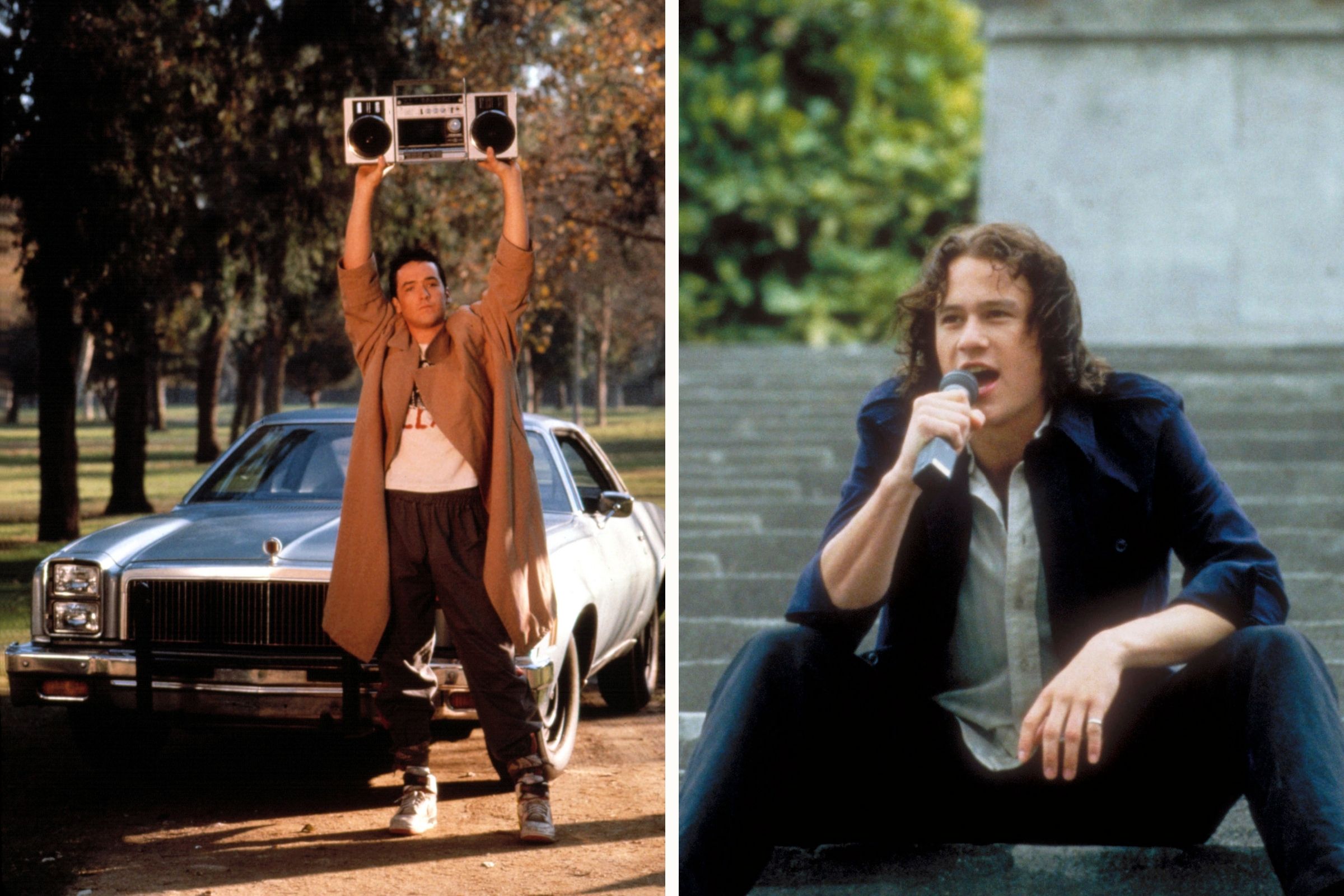
Decades of romantic comedies have taught us that words are cheap. Simply saying “I love you” is not enough to get the girl (or rarely, the guy). You need to add gravitas, to go big and bold, to make a grand romantic gesture.
But these gestures are only truly romantic when they express vulnerability or make amends without pressuring the other person to reciprocate. In the classic 80s movie _Say Anything_, John Cusack’s character Lloyd Dobler famously holds a boombox over his head and blasts Peter Gabriel’s “In Your Eyes” into the bedroom window of Diane Court, the girl who broke up with him. In the 90s romantic comedy _10 Things I Hate About You__,_ bad boy Heath Ledger’s character takes over the high school football stadium’s PA system to sing and dance his way back into his riot-grrrl love interest’s good graces.
The aughts brought us Ryan Gosling hanging off a Ferris wheel and threatening to let go if his love interest didn’t agree to go on a date with him in _The Notebook_, and Kathryn Heigl jumping off a dock onto a departing wedding boat to bare her heart into a microphone to James Marsden and the rest of the wedding guests in _27 Dresses__._ Grand gestures are supposed to be romantic and uplifting, but in the real world, many of them would likely raise more concerns than spirits. After all, having someone risk arrest (_Fever Pitch_), throw themselves in front of a car (_Hitch_), or sacrifice their career for you (_The Proposal_) comes with an awful lot of pressure. This pressure can help us understand why most grand romantic gestures should probably be kept to the silver screen.
Last year, Dan Pink, author of _The Power of Regret_, and I sat down on the “Love, Factually” podcast to debate the upsides and downsides of grand romantic gestures. In a survey, Dan collected over 16,000 regrets from people across the globe, and a huge number of these regrets, regardless of age, gender, or geography, involved situations in which one person was romantically interested in another person, but failed to pursue that person as boldly as they felt they should have. People reported incidents from 10, 20, even 40 years ago, and claimed to have regretted their inaction ever since.
One person described meeting a woman on a train and spending an amazing train ride together. When they got to her stop in Belgium, he said he would get off with her, but she said no. Instead, they kissed, he gave her his mailing address, and they never saw each other again.
The man told Dan he has always regretted not getting off the train with her in Belgium 40 years ago. In my research, on the other hand, I have found that it is harder for people to say no to us than we think. I’ve found this to be true when we are asking people to do us a favor, to do something unethical like lie on our behalf, and also when making romantic advances.
Extract — continue reading at the source.