During World War II, the United States raced to develop the atomic bomb partly out of fear that Nazi Germany might build one first. But how close did Germany actually come to achieving that goal? A new scientific investigation suggests the Nazi nuclear program was much further from success than its leading physicist claimed.
By examining surviving uranium cubes and previously documented historical evidence, researchers have uncovered major limitations in Germany's final experimental nuclear reactor. Their findings indicate that the project was not simply missing a few materials. The reactor would have required far more uranium and heavy water than Germany had available during the war.
The Manhattan Project, the secret American effort to develop nuclear weapons during World War II, was driven partly by the possibility that Nazi Germany might achieve a similar breakthrough first. Scientists knew that whoever succeeded could gain an unprecedented military advantage. One possible route to an atomic bomb involved building a nuclear reactor capable of producing plutonium, a radioactive element that can be used in nuclear weapons.
Inside a reactor, uranium atoms undergo nuclear fission, a process in which their nuclei split apart and release energy along with additional particles called neutrons. Under the right conditions, those neutrons trigger further fission reactions, creating a sustained chain reaction. Although Nazi Germany pursued nuclear research through a program known as the Uranprojekt, historians have long debated how close its scientists came to developing a functioning reactor.
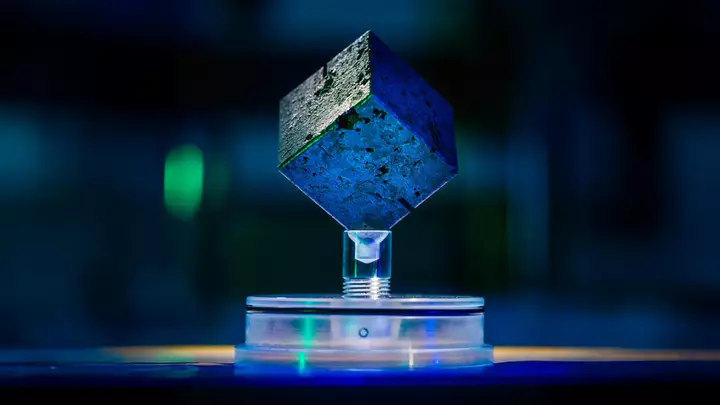
Germany's final attempt was an experimental reactor known as the B8 pile, constructed in 1945 under the direction of physicist Werner Heisenberg. The device used cubes of natural uranium suspended in heavy water, a specialized substance that played an essential role in controlling the nuclear reaction. Why Heavy Water Was Essential to Nazi Germany's Reactor Heavy water looks much like ordinary water, but its hydrogen atoms contain an additional neutron.
This subtle difference makes it particularly useful in certain nuclear reactors. In a reactor, heavy water serves as a neutron moderator, meaning it slows down the neutrons released during fission. Slower neutrons are more likely to trigger additional fission reactions in uranium, helping sustain the chain reaction needed for a working reactor.
Extract — continue reading at the source.