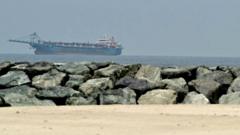
There's no doubt the US military has the capability to mount a blockade of vessels moving in and out of the Gulf. The question is: to what end? "I do think it's doable," retired US Rear Admiral Mark Montgomery told the BBC this morning.
"And it's certainly less risky than the alternative, which would have been to forcibly push back the Iranians and create the conditions for a convoy." Some of the options floated by President Trump in recent weeks – the seizure of Kharg Island or militarily escorting convoys through the Strait of Hormuz – would have proved hazardous and potentially costly. US forces involved would have exposed themselves to attack from Iranian missiles, drones and fast boats. The possible presence of mines in the water would have added another layer of danger.
By contrast, a blockade allows US warships to loiter safely, far offshore in the waters of the Gulf of Oman, track vessels emerging from Iranian ports and interdict them at will. "There's less risk in this than there is in the very confined area of the Strait," Admiral Montgomery said. With special forces, helicopters and its own fast boats all available, the US navy has all the assets it needs for such an operation.
Recent blockades of Venezuela and Cuba have demonstrated the capability. In early January, the seizure of the Russian oil tanker, the Marinera, far out in the northern Atlantic, showed that such operations can be carried out almost anywhere. US Central Command (Centcom) says the latest blockade "will be enforced impartially against vessels of all nations entering or departing Iranian ports and coastal areas," but that vessels using non-Iranian ports will not be stopped.
Ships carrying humanitarian supplies, Centcom says, will be permitted, but "subject to inspection." The logic seems clear. Since the war began, Iran has successfully continued to export its own petrochemicals through the Gulf, earning billions of dollars while preventing other Gulf countries from exporting their own hydrocarbons. A successful US blockade could halt that flow, robbing the Iranian regime of badly needed revenue and weakening its economy still further.
But Iran, which has already shown enormous resilience in the face of more than a month of attacks by the US and Israel, may well feel that it can weather yet another storm. Especially as any fresh blockade is likely to push up oil prices still further. "They believe they can outweigh this," David Satterfield, a former US special envoy for Middle East humanitarian affairs, told the BBC, "that the US will feel pain from oil prices and that the Gulf states will pressure the US, ultimately, to get the Strait open again." Washington, he says, has failed to take account of Iran's steely determination.
Extract — continue reading at the source.