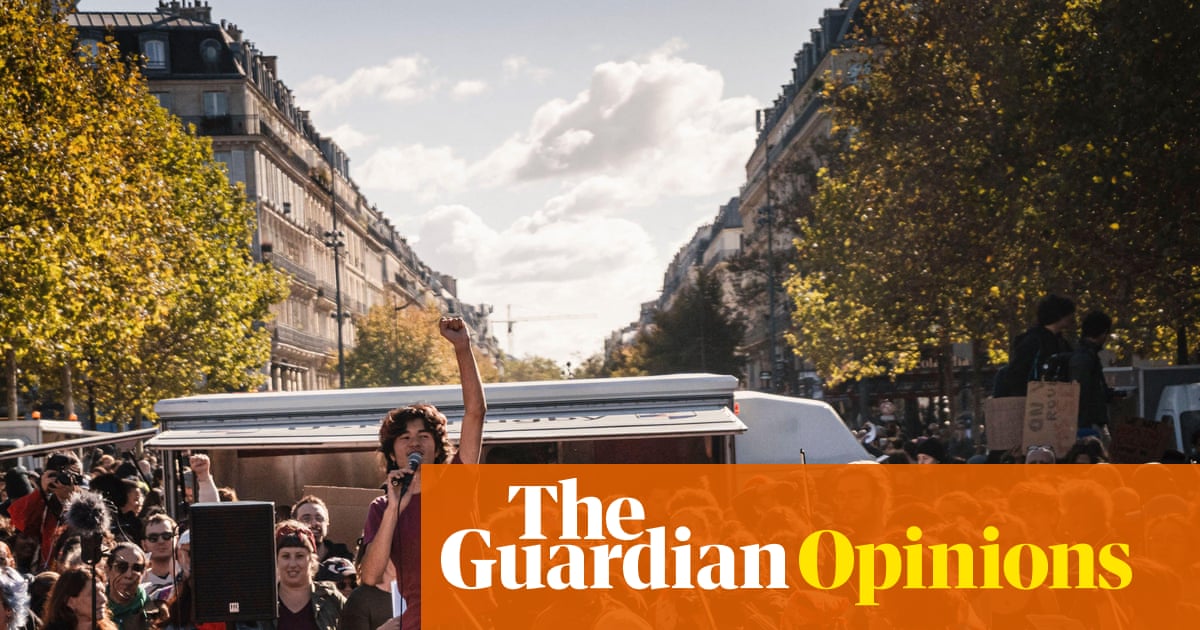
They were the last people standing – or rather playing – during last week’s student protests in France, as gas canisters landed in double-bass cases. L’Orchestre du Nouveau Monde, co-founded by young conductor Étienne Jarrier and his friends when they were still teenagers, aren’t a typical orchestra. With their manifesto of activism and social justice, the orchestra is not “a sacred object of beauty, but a tool for struggle”, through civil disobedience, outreach in schools, demonstrations and concerts, all to “present a different kind of classical music – one reconnected to reality”.
The new world Jarrier and his group dream of is “anti-racist, anti-capitalist, feminist, environmentalist and committed to de-growth”, and their way of working is deliberately provocative, not only to so many of the dominant directions of travel in the political world, but also to the institutions of classical music. They play scrappily passionate performances of La Marseillaise, of music from The Avengers, of Dvořák’s New World Symphony and protest songs but the ONM judge the quality of their performances not by playing the right notes in the right order, but by their consciousness-raising impact, whether they’re staging performances at Place de la République in Paris or at the foot of a glacier. This is not an orchestra trying to find hermetically sealed concert halls to perform in perfect acoustics.
It’s a group that wants to be out on the streets, outside television studios and the headquarters of corporations, institutions or industries they choose to protest against. They don’t want their audiences to listen in silence but to sing with them, move with them, shout with them. All of this seems like a radical overturning of the way that orchestras usually function – and the ONM is arguably the most self-consciously radical orchestral assembly right now in how it fuses its political purpose to its musical ideals.
In its political idealism and aesthetic radicalism, the ONM is a contemporary cousin of two British orchestras founded in 1969 and 1970: the Scratch Orchestra and the Portsmouth Sinfonia. Composers Cornelius Cardew, Howard Skempton and Michael Parsons founded the Scratch Orchestra in 1969. Cardew’s The Great Learning, based on texts by Confucius, is the Scratch Orchestra’s magnum opus, its notation and performance realised the Scratch Orchestra’s goals: to make music as open as possible to participants of all abilities and backgrounds.
Instead of classical music’s polished perfection, the Scratch Orchestra’s experimentalism was an aesthetic of radical inclusion – socially, musically and aesthetically. The Great Learning’s greatest learning of all was that music of this ambition and scale belongs to anyone who wants to play it. The Scratchers went on to be welcome by the very institutions they critiqued, playing the Proms in 1972; but Cardew’s increasingly devoted leftwing activism took his music down a different course and the orchestra disbanded in 1974.
For the Portsmouth Sinfonia, the self-styled “world’s worst orchestra”, the point was to try to play the classics – piano concertos, symphonies, orchestral hits – on instruments that the musicians, which included Gavin Bryars, Brian Eno and Michael Nyman, didn’t actually know how to play. The delirious, joyous and utterly deliberate cacophony that resulted remade everything from Beethoven’s symphonies to Handel and Hooked on Classics. (The Portsmouth Sinfonia’s attempt to disco-ify the classical repertoire parodied the Royal Philharmonic’s chart-topping kitschorama, and reached no 38 in the charts in 1981: Classical Muddly. Listen to it here, and enjoy.
Extract — continue reading at the source.