Finding love isn’t always easy—especially if you’re a southern cassowary, a massive, solitary bird with an aggressive reputation. But conservationists in Australia seem to have cracked the matchmaking code: A female cassowary recently laid two eggs after being paired with a potential mate. The large, bright green orbs are the first southern cassowary eggs laid at Adelaide Zoo in South Australia in more than three decades—and their arrival is an encouraging bright spot for a species facing an uncertain future.
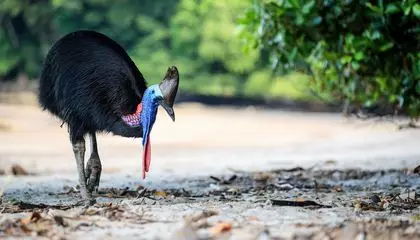
Native to Australia, southern cassowaries are huge flightless birds found primarily in Queensland’s Wet Tropics and Cape York Peninsula; they also live in New Guinea and eastern Indonesia. Weighing up to 175 pounds and standing more than five feet tall, they’re the third-largest birds in the world, trailing behind emus and ostriches. Beyond their imposing size, southern cassowaries are known for their striking appearance.
Inky-black feathers cover most of their bodies, contrasting with vibrant blue necks, two dangling red wattles and a Mohawk-like casque—a raised, bony structure—atop their heads. Scientists don't know why cassowaries have casques atop their heads. But they recently discovered that this helmet-like head ornament fluoresces under ultraviolet (UV) light, a discovery that only deepens the mystery.
Southern cassowaries have been recorded eating more than 200 different kinds of plants, and they play an important role in maintaining rainforest diversity by dispersing seeds via their droppings. They’re mostly solitary creatures, but they aren’t afraid to use their powerful legs and sharp claws to defend their turf when necessary. The International Union for Conservation of Nature considers southern cassowaries a species of least concern, but Australia lists them as endangered, with an estimated 4,400 individuals remaining on the continent.
Their survival has been threatened primarily by habitat loss and fragmentation resulting from forest clearing for agriculture and infrastructure, but the species is also vulnerable to vehicle strikes, poaching, dog attacks and competition with feral pigs. Some Australian zoos have captive populations, which are part of a breeding program managed by the Zoo Aquarium Association Australasia (ZAA). The organization maintains a studbook to help determine which birds should breed, with an overarching goal of maintaining genetic diversity.
Earlier this year, staff at the Adelaide Zoo got the go-ahead to try breeding their resident southern cassowaries: 10-year-old Martina and 13-year-old Jeffrey. Though the two birds seemed like a good match on paper, there was no guarantee sparks would fly when they met in person. Chad Crittle, the zoo’s director, compared the team’s matchmaking efforts to online dating, where it “might look like everything lines up really well.
Extract — continue reading at the source.