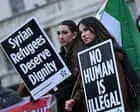
I am a refugee and I am in shock at the home secretary’s announcement that people like me will now have to wait up to 30 years before they can apply for settlement in the UK – a sixfold increase on the current time period. It feels like a pile-on at a time when asylum seekers and refugees are already facing a barrage of hostility in this country. Even before the announcement, refugees felt under siege.
With the withdrawal of the right to ever become citizens for those of us who have “made a dangerous journey” and with frequent reviews of our refugee status to check if we are still deserving enough of protection or if we should be deported, our security in the UK is more vulnerable than ever. According to the new rules, particular restrictions will be reserved for refugees who arrive in the UK on small boats or by other clandestine means such as in freight lorries. This is a punishment for fleeing war and using the only option open to us to reach a safe country.
The government talks a lot about how asylum seekers will be treated differently if they arrive by safe and legal routes. The problem is that almost none exist: the largest scheme, refugee family reunion – which allowed about 20,000 women, children and other eligible dependents to join recognised refugees in the UK – has been suspended for more than a year. The government has promoted other refugee resettlement schemes, such as one which will include Palestinians and Afghan women and girls, and another where refugees are supported and sponsored by individual communities.
However, as well as only supporting small numbers of people, both have restrictions and limited scope, leaving those desperately trying to escape conflict zones with a binary choice: stay put or use an illegal method to reach safety. Shutting the most vulnerable refugees out of settled status for 30 years places us in a state of limbo that will only deepen the trauma of fleeing our home country. This will cause refugees to disengage with the state, which will force more of us underground, working illegally for very low wages, and make us more vulnerable to exploitation.
If more of us start to live under the radar, the government will ultimately have less rather than more control over irregular migration. This will also only hinder integration. It’s much harder to feel we belong in society if we’re shut out of settlement – even if we have a legal right to live here.
I arrived in the UK in 2017 after fleeing Syria. I protested against the Assad regime during the Arab spring and Syria’s civil war, and was twice imprisoned. When I was almost killed in a deadly missile attack in a suburb of Aleppo in 2017, I fled first to Turkey and then arrived in Calais in France and went on to the UK, where I joined my aunt, who raised me after my mother died.
Extract — continue reading at the source.