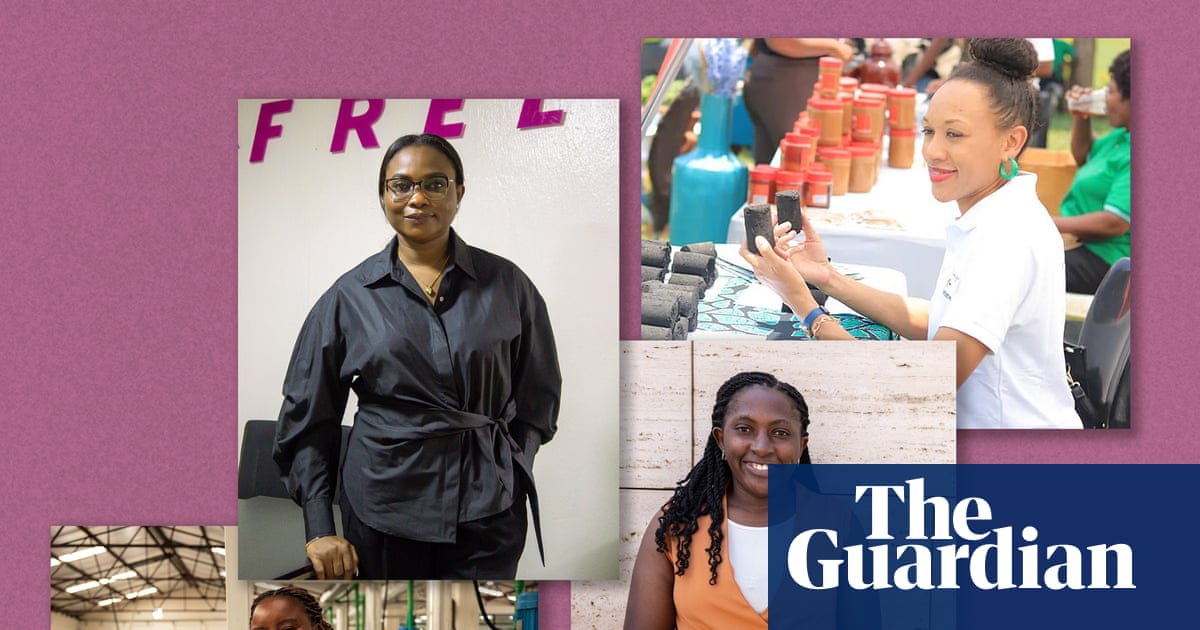
Africa is thought to have a higher proportion of female entrepreneurs than any other continent and yet many still struggle to access financing. Four business leaders from Nigeria, Uganda, Kenya and Malawi tell us about the inspiration behind their success – and the challenges women still face. On the outskirts of Ibadan in south-west Nigeria, thousands of discarded tyres are fuelling an industrial experiment.
They arrive at Freee Recycle’s factory where they are sorted, shredded and reduced to rubber granules. Some will become playground surfaces. Others will be turned into gym flooring, paving blocks and interlocking tiles.
Ifedolapo Runsewe, the company’s founder, is building an industrial recycling business in a sector where women rarely own factories or lead manufacturing operations. In Nigeria, women own about 40% of small businesses, but 56% of female entrepreneurs’ last loan applications were denied, compared with 17% for men, according to the World Bank. In capital-heavy fields such as recycling, this financing gap may prevent female entrepreneurs becoming factory owners.
Runsewe has made that leap. She has built a factory that turns one of Nigeria’s most intransigent waste problems into products. The factory employs about 62 people, collecting tyres from four states in Nigeria: Oyo, Lagos, Osun and Kwara.
Nigeria produces millions of waste tyres each year. Many end up in dumps or are burned to recover scrap metal, releasing hazardous pollutants. After more than 12 years in banking, Runsewe became interested in tyre recycling after seeing first-hand the impact of burning tyres.
What convinced her there was a business opportunity was the fact that almost every part of a tyre can be recovered and reused. She started Freee Recycle in 2020. The challenge has been to convince people that waste can be a business.
Extract — continue reading at the source.


