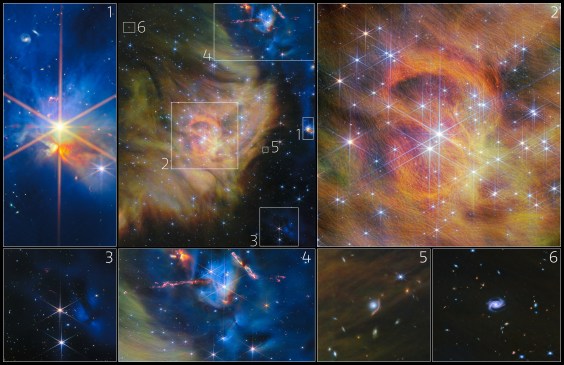
At its original size, it’s 30,866 x 38,204 pixels, so we’re looking at about 1.8 billion pixels rendering a slice of space roughly 5 light-years across. Read more: “James Webb Space Telescope Captures the Cigar Galaxy’s Brilliant Stellar Halo in Pristine Detail” The region is officially known as IC 348, and it’s around 1,000 light-years away from Earth, in the Perseus constellation, a close neighbor given the scale of the universe. It’s also a well-known star factory.
In fact, in this image, you can see some young stars as bright blue dots, with spokes of light emanating from them (actually caused by the optics of the JWST, rather than the stars themselves). Star-hunting is the main scientific aim of the image, though its aesthetic appeal doesn’t hurt. The JWST is looking for brown dwarfs in the region—that is, celestial objects that never quite make it to full star status.
The telescope has now identified brown dwarfs that have the equivalent mass of two Jupiters, the lightest of these objects to ever be observed, and much lighter than theoretical models had predicted. For comparison, they’re less than 0.2 percent of the sun’s mass. It was all captured by the NIRCam (Near-Infrared Camera) on the JWST, which is able to pick up the low-energy signals emerging from brown dwarfs—an impressive feat, considering these celestial bodies are cool and dim compared to the bright stars around them.
You can’t actually see them in this picture unless you have it up at full resolution and a trained eye to spot them. Brown dwarfs never get hot enough to fuse ordinary hydrogen into helium—they don’t ignite, basically—and these new observations might shift our thinking about the processes through which stars form (or don’t). The findings also further blur the line between stars and planets as one of the super-light brown dwarfs shows signs of a disk forming around it.
Meanwhile, in the the top right corner of the image, there’s a bunch of protostars still gathering dust to get bigger, and sometimes throwing out jets of gas and dust that are more apparent than the protostars themselves. These are known as Herbig-Haro objects and are visible as bright, straight bars of color. You can get a closer look at one of them here.
It’s a glimpse into an interstellar world only the JWST can provide. Subscribe to our free newsletter. Lead Image: NASA, ESA, CSA, Kevin Luhman (PSU), Catarina Alves de Oliveira (ESA), Mahdi Zamani (ESA/Webb)
Extract — continue reading at the source.


/https://tf-cmsv2-smithsonianmag-media.s3.amazonaws.com/filer_public/1a/e7/1ae729d1-7a37-4650-b971-dfdb66c8f7a8/eo_pe_iss062e117852_sm.webp)