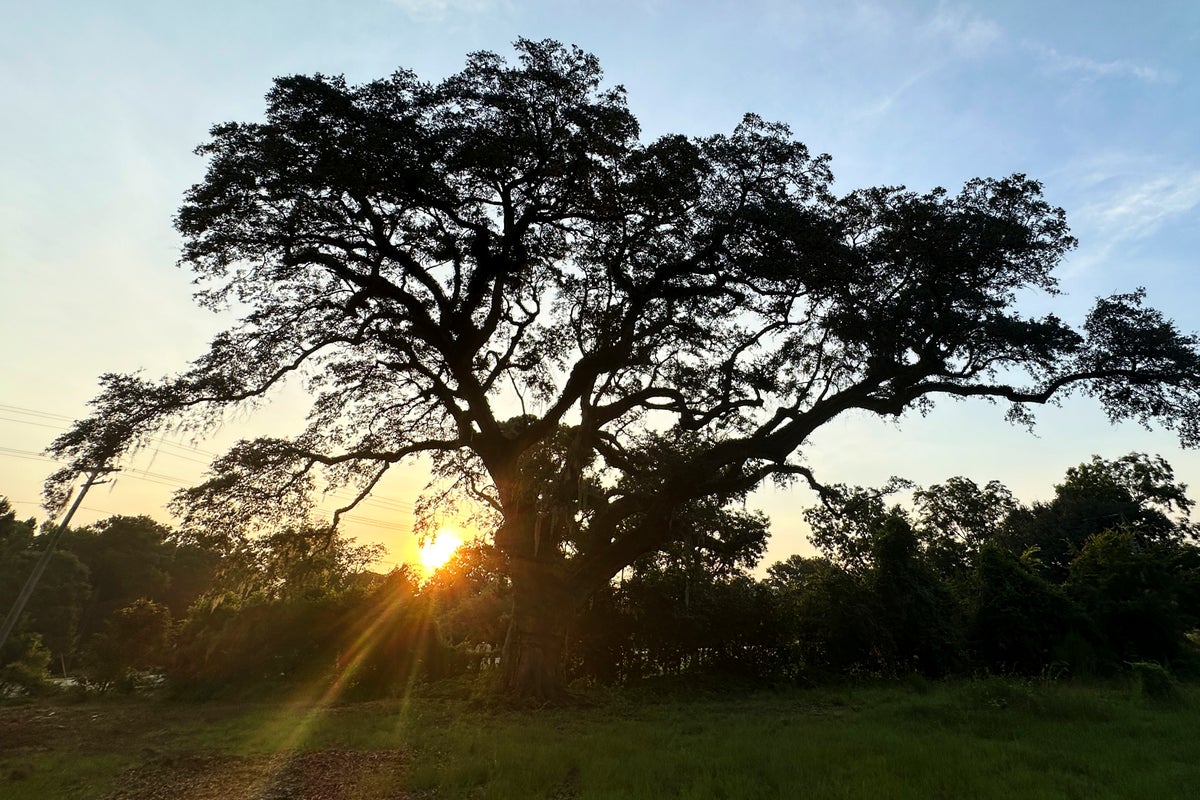
A massive live oak that stood on a South Carolina battlefield during one of the Revolutionary War’s bloodiest clashes is now fighting a battle of its own — against the decades-old measures once designed to save it. The scarred oak at Eutaw Springs is believed to be nearly 300 years old. Arborists estimate it was about 50 when American and British forces fought around it on Sept. 8, 1781.
Known as a “witness tree,” it is a rare living link to the Battle of Eutaw Springs, which historians consider the final major open-field engagement of the Revolutionary War. British troops may have rested in its shade before the fighting or used its trunk for cover as American forces advanced. About 2,500 American troops under Maj.
Nathanael Greene attacked roughly 2,000 British and Loyalist forces near a fortified brick structure. Among the notable officers involved were Lt. Henry “Light-Horse Harry” Lee and Brig.
Francis Marion, the famed “Swamp Fox.” The fighting was brutal. Greene, who had a horse shot from beneath him, later described it as “by far, the hottest action I ever saw, and the most bloody for the numbers engaged.” British commander Lt. Alexander Stewart similarly called the battle “bloody and obstinate.” A total of 1,461 men were killed, wounded, captured or reported missing, and both sides claimed victory.
The armies eventually disappeared. Today, the tree stands about 45 feet tall, with a sprawling canopy stretching roughly 130 feet. Its trunk measures about 6 feet across at chest height.
It also survived dramatic changes to the surrounding landscape. The springs that gave Eutaw Springs its name disappeared in the 1940s when a reservoir was created in the Santee River basin, while 1960s development consumed more of the historic battlefield. Then, about 50 years ago, lightning split the oak near the center of its trunk.
Extract — continue reading at the source.