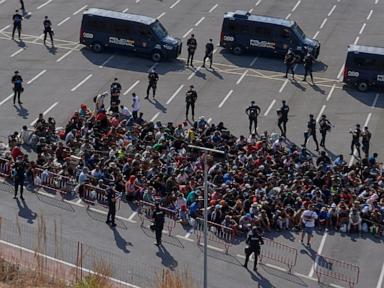
Migrants in Ceuta have been moved to makeshift shelters by Spanish police CEUTA, Spain -- For weeks, migrants in the Spanish territory of Ceuta had gathered on a beach away from the city center, sleeping on cardboard sheets, under reed huts and guarding their few possessions in tattered plastic bags. They were gone by Thursday morning after Spanish police escorted them to makeshift shelters. But an hour later, other migrants were combing through the trash they had left behind for anything useful: an abandoned mattress, plastic chairs, sheets, a scrap of tarp.
The scene exemplified the ongoing humanitarian crisis in Ceuta, where up to 10,000 migrants, including women and children, have remained in the city weeks after the initial border surge that saw more than 72,000 migrants pour into the small Spanish territory neighboring Morocco. Three weeks later, Spanish authorities were struggling to shelter and attend to those who refused to leave — or even determine exactly how many migrants were still in the city of 84,000. Within days of the initial border rush, in which at least 90 people died, most migrants returned to Morocco, confronted with the difficulty of staying in Ceuta and their slim chances of reaching mainland Europe from the exclave.
But thousands remained, hiding in the hills surrounding the city, on beaches and outside a migrant reception center. City officials estimate that 9,000 to 10,000 migrants — including about 2,000 minors — could still be in the city, based on the number of daily food rations handed out by aid groups. Spain’s interior ministry puts the figure at roughly 5,000 people.
The U.N. refugee agency highlighted large humanitarian and operational challenges in Ceuta in an interview with The , specifically around migrants' access to shelter, basic services and food. While most of those who crossed in late July are from Morocco, people from war-torn Sudan, Mali and Yemen also made the crossing. The U.N. refugee agency has urged the Spanish government to start processing their asylum claims as soon as possible, estimating that about 1,200 migrants in Ceuta could be eligible for international protection, according to Paula Barrachina, a spokesperson for the agency in Spain.
The Spanish government says it is working to house the remaining migrants in the city, and return a sense of normalcy to Ceuta. On Thursday, Spain’s Minister of Inclusion, Social Security and Migration Elma Saiz said the government had secured space to accommodate 1,800 migrants in a parking lot and a military facility sometimes used for religious events. Even so, an photographer saw migrants roaming the streets Thursday.
Elsewhere, hundreds of women and minors were sheltering in makeshift centers run by locals. Khadija Rifai, a 20-year-old woman from Morocco, acknowledged that some migrants were receiving help, but didn't know what Spain planned to do with adults like her. Rifai said her life in Morocco was “normal” but in late July, she and her husband swam to the Spanish territory in search of better opportunities and healthcare.
Extract — continue reading at the source.