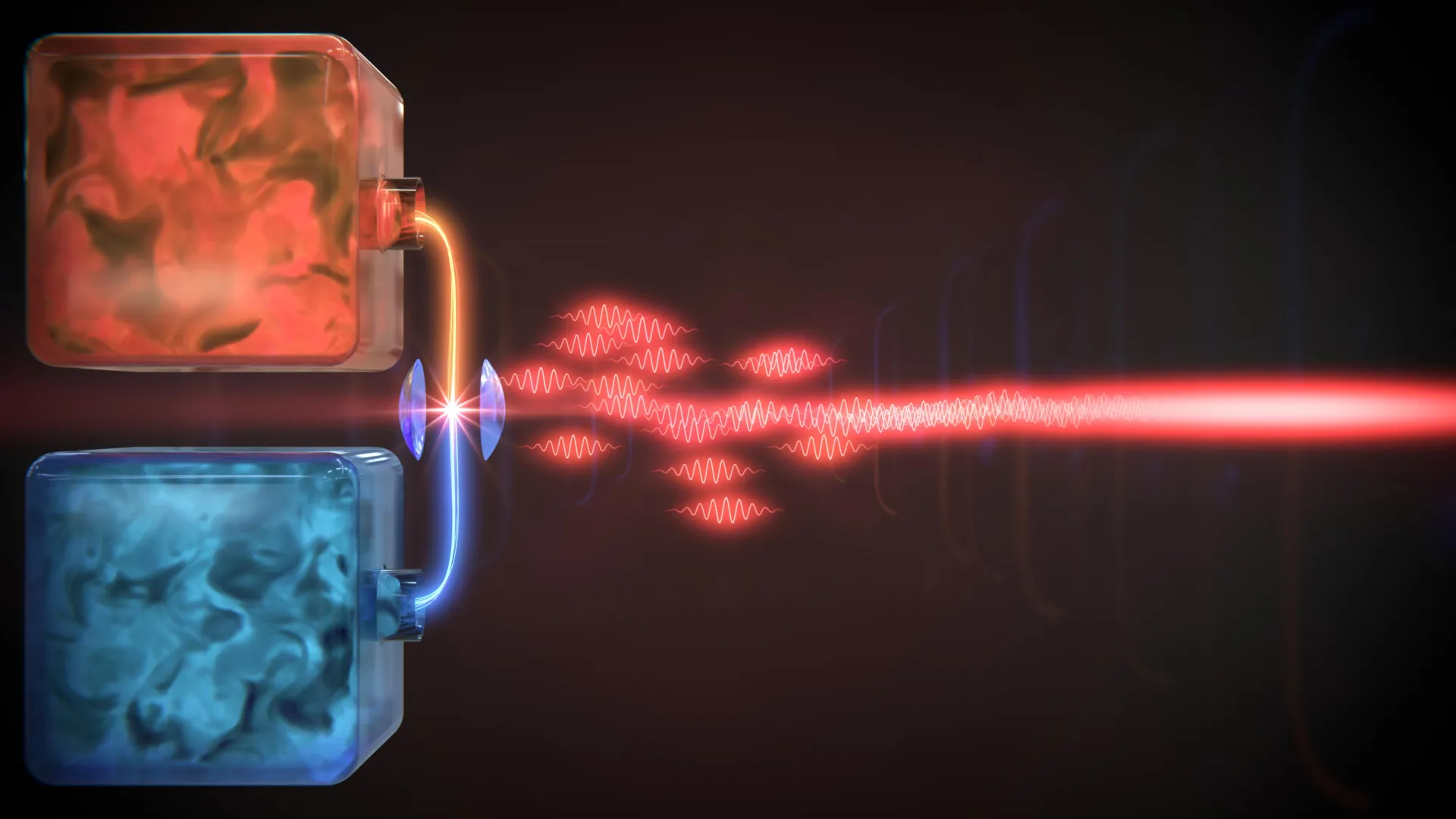
What counts as heat, and what qualifies as useful work when a machine is made from only an atom and particles of light? In emerging quantum technologies, questions like this bring together two branches of physics that were developed for very different purposes. Researchers at the University of Basel in Switzerland have now introduced a theoretical framework designed to make thermodynamics and quantum physics work consistently in the same setting.
Thermodynamics emerged in the 19th century largely to explain how large machines such as steam engines convert and transfer energy. Quantum physics, developed in the early 20th century, instead focuses on atoms and subatomic particles. Today, however, the two fields increasingly overlap.
Tiny systems built from atoms and light particles (photons) can take in energy, transform it, and release it, allowing them to function as microscopic quantum machines. A major challenge is finding a description that remains valid both when the entire system is treated quantum mechanically and in the semi-classical limit. The latter is the limiting case in which one part of the system is treated quantum mechanically, while classical physics is sufficient for the other part.
Researchers in the group of Professor Patrick Potts at the University of Basel have now presented such an approach in Physical Review Letters. "Our calculations regard the concrete physical model of an atom that is placed in a cavity between two mirrors, where it can absorb and emit light particles," says postdoc Marcelo Janovitch. In this setup, a laser continuously supplies additional photons to the cavity, while some light escapes through the partially reflecting mirrors.
"This is a textbook example of a so-called driven-dissipative system that continuously receives energy and simultaneously loses it to the environment," says the researcher. The model gives physicists a way to investigate fundamental questions involving open quantum systems. In this case, the atom behaves much like a miniature heat engine, or more specifically, a "light engine." Potts and his collaborators had previously shown that photons leaving the cavity should not automatically be treated as "waste heat" in a thermodynamic description.
Some of the energy carried by that escaping light can still be used to perform useful work on another quantum system. Their latest study examined what happens to this distinction between heat and useful energy when the system approaches the semi-classical limit. In the semi-classical limit, the atom inside the cavity continues to be treated as a quantum system with discrete energy levels.
Extract — continue reading at the source.