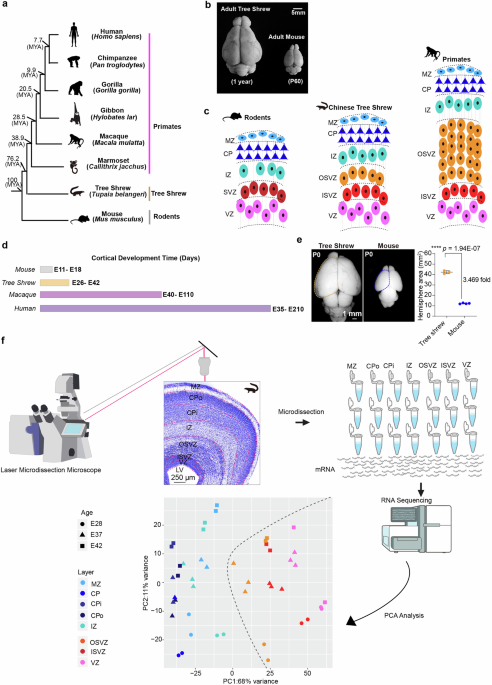
A defining feature of primates is the expansion and increased complexity of the cerebral cortex, processes that are largely associated with evolutionary adaptations of the neural progenitor-enriched outer subventricular zone (OSVZ). Yet, the genetic mechanisms underlying the emergence of the primate OSVZ remain unknown. The tree shrew is a closer outgroup to primates than rodents, its brain exhibits an intermediate phenotype; while being lissencephalic, it nonetheless possesses an OSVZ.
Here, we applied laser microdissection technology to conduct comprehensive gene expression analyses of different cortical layers in the tree shrew brain across three key developmental stages. We show that cell cycle-related genes are already involved in the tree shrew OSVZ. In contrast, extracellular matrix-associated pathways appear to be unique to the primate OSVZ.
Furthermore, overexpression of ZNF664 significantly increased intermediate progenitor proliferation in the mouse subventricular zone. Together, these results reveal shared molecular mechanisms underlying OSVZ development in primates and tree shrews, providing insights into the origin of primate cortical complexity. The increase in brain complexity and cognitive abilities has distinguished humans from other non-human primates1,2.
Numerous comparative analyses between humans and non-human primates have highlighted that genetic changes have driven the evolution and development of human cortical phenotypes2,3,4, including human accelerated regions5, sequence changes in protein-coding6,7 and noncoding genes8,9, segmental duplications and other structural variations10,11, alterations in epigenetic regulation12,13, and changes in gene expression14,15,16. It is important to note that many human-specific traits originated in ancestral lineages, such as those leading to primates17,18,19. However, the genetic changes contributing to the emergence and evolution of primate phenotypes, particularly the complexity of primate brains, remain poorly understood.
Brain evolution is tightly linked to cortical development processes19,20,21, which ultimately depend on the behavior of neural progenitor cells (NPCs)22,23. NPCs are distributed across two germinal zones: the ventricular zone (VZ) and the subventricular zone (SVZ), which lies basal to the VZ. Apical progenitors (APs) are primarily located in the VZ, where they span the entire cortical wall during neurogenesis, whereas basal progenitors (BPs) accumulate in the SVZ24.
BPs are derived from APs and mainly comprise intermediate progenitor cells (IPCs) and basal radial glial cells (bRGCs). The mouse fetal cortex contains a VZ and a comparatively thinner SVZ. In primates, the SVZ is markedly expanded and further subdivided into the inner SVZ (ISVZ) and the outer SVZ (OSVZ), which are demarcated by a thin fiber layer25,26,27,28.
Extract — continue reading at the source.