Microglia play a crucial role in maintaining homeostasis of the central nervous system, whereas their dysfunction is implicated in the pathogenesis of various neurological diseases. Nevertheless, interspecific genetic differences pose challenges to translating findings from conventional rodent models. Human pluripotent stem cell-derived microglia offer a genetically relevant alternative, but these cells undergo profound transcriptomic changes and lose key homeostatic features when isolated from physiological brain cues.
Accordingly, research has increasingly focused on advanced modelling platforms designed to restore the microenvironment required for in vivo microglial identity and functionality. This review examines the evolution of human microglial platforms, encompassing foundational generation protocols and multicellular integration. The discussion extends from two-dimensional co-cultures to three-dimensional brain organoids and includes human microglia chimeric models established via xenotransplantation to provide a physiological niche.
In summary, the human pluripotent stem cell-based approach represents a valuable experimental pipeline for microglia research, facilitating the investigation of polygenic structures underlying human neurological diseases, from high-throughput screening to in vivo preclinical validation. Microglia are the primary resident macrophages in the central nervous system (CNS), where they regulate neural development, sustain synaptic networks and respond to pathological stimuli. Genetic analyses have demonstrated that risk variants for neurodegenerative and neurodevelopmental disorders are enriched in microglial genes, underscoring the significance of microglia-mediated neuroinflammation in disease pathogenesis.
Rodent models have historically contributed to foundational insights into microglial biology; however, interspecies genetic divergence restricts their translational relevance. Notably, numerous human-disease-associated risk variants lack functional orthologues in mice. Additionally, primary human microglia isolated from brain tissue undergo rapid transcriptomic alterations, losing homeostatic markers and exhibiting artefactual activation states under standard in vitro conditions.
To overcome these challenges, human pluripotent stem cell (hPSC)-derived microglial models have been developed. Such platforms preserve human genetic features and enable the incorporation of microglia within controlled environments. This review summarizes the progression of hPSC-derived microglia models, spanning planar co-cultures, three-dimensional organoids and chimeric brain xenografts.
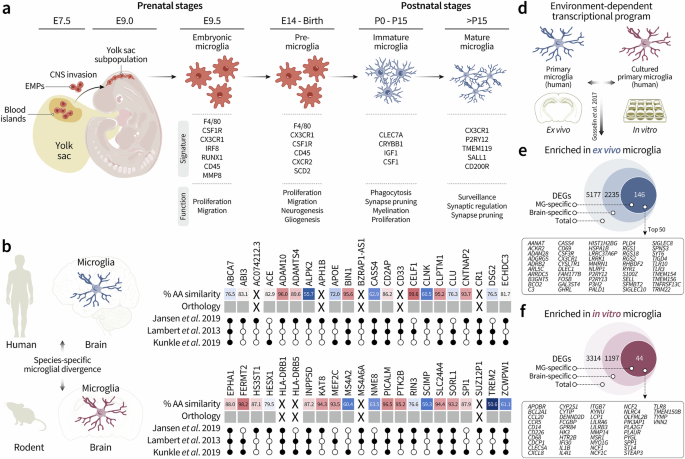
Furthermore, we examine how these complementary platforms facilitate advances in neuroimmune research and preclinical therapeutic assessment. Microglia, the resident immune cells of the CNS, originate from yolk-sac-derived erythromyeloid progenitors during early embryogenesis and persist as a self-renewing population independent of definitive haematopoiesis1,2. Their maturation and maintenance rely on colony-stimulating factor 1 receptor (CSF1R) signalling and key transcription factors (TFs), notably PU.1 and IRF8 (ref.3) (Fig. 1a).
Extract — continue reading at the source.


