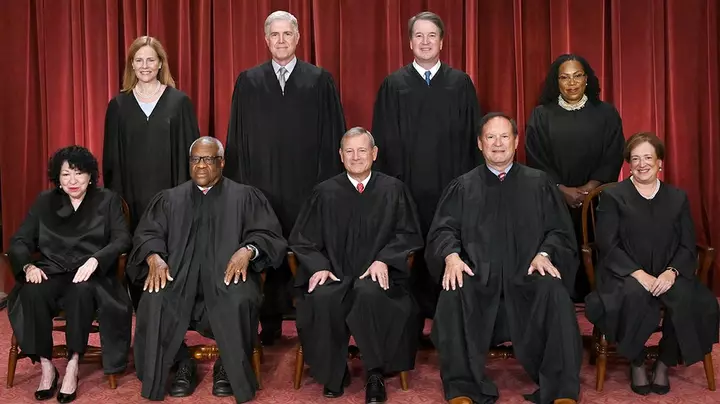
Conservative Supreme Court Justice Neil Gorsuch has joined forces with liberal Justice Sonia Sotomayor to question the federal government's prosecution of an illegal immigrant, marking the latest unlikely alliance between the two justices. Gorsuch, appointed by President Donald Trump, and Sotomayor, appointed by former President Barack Obama, raised concerns about the government's decision to prosecute a Mexican national twice for being found unlawfully in the United States — even after a federal court prohibited him from leaving the Eastern District of Oklahoma following his first conviction. The unlikely pairing emerged Tuesday when the Supreme Court declined to hear an appeal from Jesus Herrera-Salazar, who argued that his second prosecution violated the Fifth Amendment's protection against double jeopardy.
Although the justices agreed the Court should not take up the case, Sotomayor issued a separate statement, joined by Gorsuch, warning of serious constitutional problems with the government's actions. GORSUCH SAYS IDEOLOGICAL DIVIDES ON SUPREME COURT COME DOWN TO ‘HOW YOU READ LAW,’ NOT POLITICS "From the moment he was released from custody after serving his first term of imprisonment, Herrera-Salazar was presented with a Hobson's choice," Sotomayor wrote in the statement joined by Gorsuch. "In the Government's eyes, whether Herrera-Salazar remained in the Eastern District of Oklahoma or left the United States, he would be breaking the law." The two justices questioned how the government could punish someone for remaining in the country after effectively prohibiting him from leaving, with the pair's joint statement describing the situation as a "constitutional absurdity." Their agreement is particularly noteworthy given their differing judicial philosophies, but it is not the first time the pair has found common ground over constitutional protections against government action.
In November 2024, Sotomayor and Gorsuch jointly questioned whether homeowners should be compensated when police destroy private property while carrying out law enforcement operations. A few months later, they again joined forces to raise concerns about warrantless misdemeanor arrests. In both cases, as in the latest immigration dispute, the Court declined to hear the appeals, but the justices issued statements highlighting constitutional questions they believed deserved attention.
The pair's latest expression of joint public concern came after Herrera-Salazar, a Mexican national previously removed from the United States, was indicted in 2020 for being found in the country following deportation, a violation of federal immigration law. 'UNPRECEDENTED': JUDGES REVEAL BEHIND-THE-SCENES COORDINATION ON TRUMP IMMIGRATION CASES He pleaded guilty and served a prison sentence before being placed on supervised release, during which he was expressly prohibited from leaving the Eastern District of Oklahoma without authorization under the terms of his release. While still under those restrictions, Herrera-Salazar was stopped by police in Heavener, Oklahoma, and subsequently charged again under the same federal immigration statute prohibiting previously deported individuals from being found unlawfully in the United States. A jury subsequently convicted Herrera-Salazar, resulting in another prison sentence and additional supervised release.
The second prosecution prompted Herrera-Salazar to challenge his conviction on double-jeopardy grounds, arguing that the government had effectively punished him twice for the same continuous period of unlawful presence. Court of Appeals for the 10th Circuit rejected that argument, concluding that the offense is completed when authorities discover a person's unlawful presence and that a subsequent discovery can support a separate prosecution without requiring another illegal entry. Sotomayor and Gorsuch questioned that reasoning, pointing to Supreme Court precedent establishing that prosecutors cannot evade double-jeopardy protections simply by dividing one continuous crime into separate periods.
Their concern was not whether Herrera-Salazar had violated immigration law in the first place, but whether the government could repeatedly prosecute him for remaining in the United States without evidence of a separate unlawful reentry. The justices also highlighted that Herrera-Salazar's supervised-release conditions restricted him from leaving Oklahoma, meaning the government was effectively preventing him from ending the conduct for which it later prosecuted him again. Sotomayor warned that, under the government's interpretation, prosecutors theoretically could have brought separate charges against Herrera-Salazar for each day he remained imprisoned following his first conviction.
Extract — continue reading at the source.