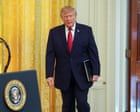
Donald Trump deflected responsibility for misleading Americans about the length of the Iran war, dismissed low poll ratings as “fake numbers” and refused to rule out the possibility of declaring a state of emergency before the midterms, in a wide-ranging interview with Time magazine. When confronted with questions about the length of the Iran war, the US president blamed the media for reporting his remarks in which he said the conflict was projected to last “four to five weeks”, in March. At the end of March, Trump had told Americans he planned to wind down the Iran war over the next “two to three weeks”.
In May, Trump insisted that a peace deal with Iran was nearly finalized. The US president said that he could have ended the Iran conflict whenever but chose to extend it “because I wanted to go further”. For more than seven months, Americans have been grappling with higher everyday costs as a result of Trump’s war with Iran – from gas prices surpassing $4 per gallon to stubborn inflation hovering at 3.4%.
Economic concerns, fueled by Trump’s conflict, have angered voters, most of whom say they are unhappy with the president’s handling of the economy and his job overall. Just 26% of adults said they approve of the economy under the Republican president, according to an /NORC Center for Public Affairs Research poll. Overall, just 31% of people said they approve of Trump’s handling of his job as president.
But when asked about his low approval rating during his interview with Time, Trump dismissed concerns. Your numbers, that you have, are fake. The pollsters are corrupt.
They’re almost as corrupt as the writers.” The US president added: “See, I’m doing very well. Look, we have the strongest economy.” Despite Trump’s assertion, Americans do not feel the same way. Approximately 74% of Americans told AP/NORC that the economy was leaning poorly.
Another 65% of survey respondents said they blame Trump’s policies directly for higher costs. Voters’ frustrations with Trump could affect Republican candidates in the upcoming midterm elections, particularly those closely aligned with the US president. Polls show many Democratic candidates making progress with voters, even in historically conservative states such as Texas.
Extract — continue reading at the source.