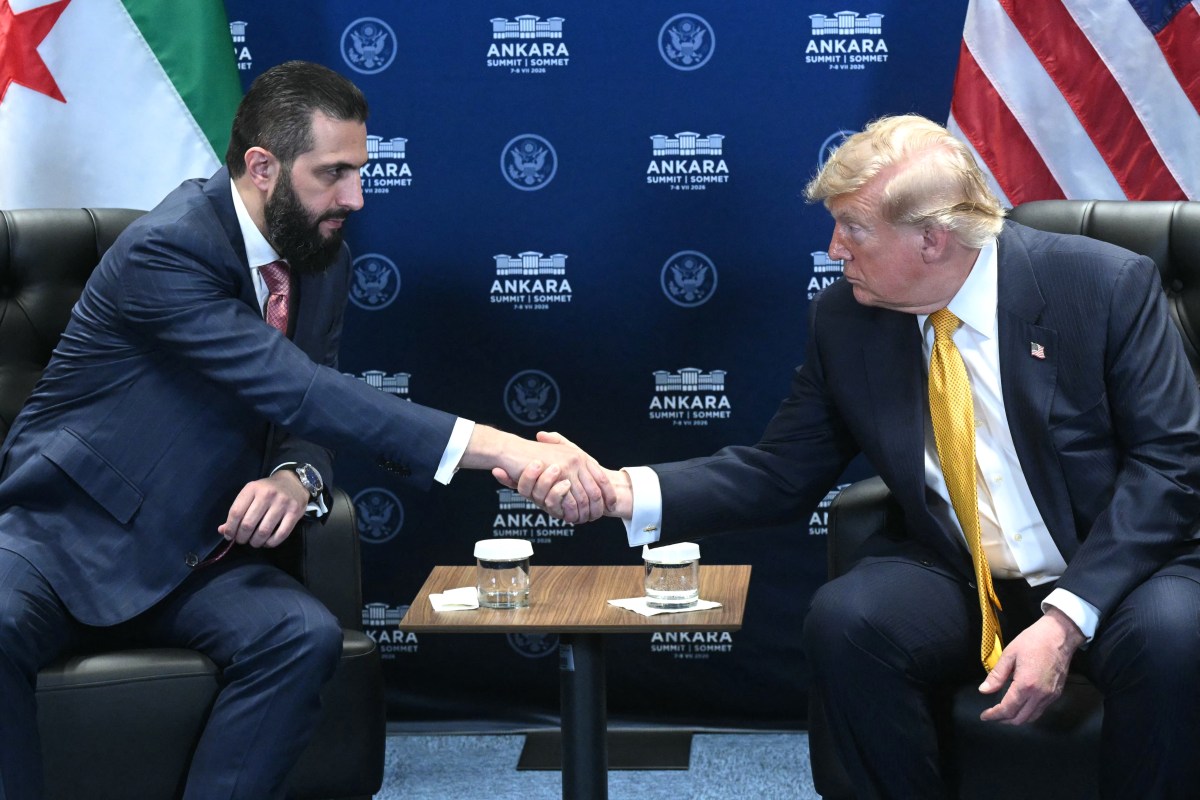
The State Department has removed Syria from the United States' list of state sponsors of terrorism following a congressional review undertaken in the wake of the overthrow of the country's former government. The decision marks the latest sign of warming ties between Washington and Damascus since the December 2024 takeover of President Ahmad al-Sharaa, a former Islamist militant chief who was also a U.S.-designated terrorist until the label was rescinded in July 2025 ahead of his first visit to the White House later that year. "These actions were all taken in recognition of the positive actions taken and further commitments by the Syrian government under President Ahmed al-Sharaa to fully distance Syria from acts of international terrorism," Secretary of State Marco Rubio said in a statement, crediting Sharaa's administration with having "taken significant steps to counter terrorism." Syria's exit would see a number of sanctions lifted against the last country still on the list since its initial establishment in 1979, when Libya, Iraq and South Yemen were also included.
Libya was removed in 2006, Iraq for the first time in 1982 and finally in 2004 and South Yemen upon unification in 1990. Sudan, added in 1993, was removed in 2020 after its decision to establish relations with Israel as part of the Abraham Accords. Today, three nations remain as U.S.-designated state sponsors of terrorism.
The U.S. designated Iran as a state sponsor of terrorism in 1984, five years after the 1979 Islamic Revolution toppled a pro-West monarchy and resulted in a 444-day hostage crisis at Washington's embassy in Tehran. With the removal of Syria, once Iran's closest ally in the Middle East under more than half a century of rule by the Assad dynasty, Iran now holds the title of the longest uninterrupted designation on the blacklist. The U.S. has justified the measure over successive administrations by pointing to Iran's support for a number of U.S.-designated terrorism organizations, including the Lebanese Hezbollah, the Iraqi Kataeb Hezbollah, Nujaba Movement, Kataeb Sayyid al-Shuhada, Harakat Ansar Allah al-Awfiya and Kataeb Imam Ali as well as Yemen's Ansar Allah, also known as the Houthi movement.
While relations briefly thawed during negotiations that culminated in the 2015 Joint Comprehensive Plan of Action nuclear deal, Trump abandoned the agreement during his first term in 2018, leading to new tensions. Trump intensified threats to Iran throughout his second term, accusing the Islamic Republic of secretly pursuing nuclear weapons and blaming Tehran for aiding in the deaths of U.S. troops in Iraq through the proliferation of improvised explosive device technology. After taking the unprecedented step of striking Iranian nuclear facilities during the 12-Day War launched by Israel in June of last year, Trump and Israeli Prime Minister Benjamin Netanyahu jointly launched a conflict against Iran in February.
The conflict remains unresolved six months later with both sides repeatedly claiming the upper hand. Cuba was first added to the list even earlier in 1982, accused of aiding leftist movements across Latin America and beyond, including the Revolutionary Armed Forces of Colombia (FARC) and the Basque Homeland and Liberty (ETA) group. The U.S. sanctions date back even further to the early years after the 1959 revolution that brought the Communist Party of Cuba to power and aligned the island nation just 90 miles off the coast of Florida with the Soviet Union.
The U.S. trade embargo that remains in place to this day marks the longest campaign of economic restrictions in modern history. Washington and Havana also experienced a thawing of ties under former President Barack Obama, who established diplomatic ties between the two nations, alleviated some sanctions measures and removed Cuba from the state sponsors of terrorism list in 2015. Trump also reversed most of these policies upon assuming office for the first time in January 2017 and ultimately added Cuba back to the list in the final days of his first term in January 2021.
Extract — continue reading at the source.