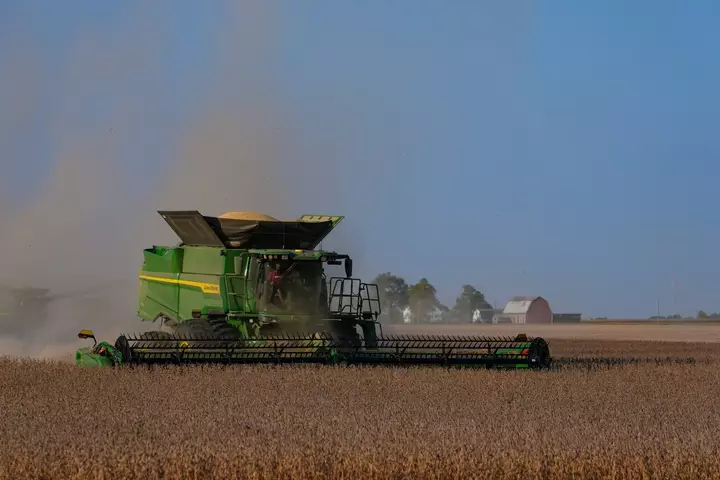
President Donald Trump's administration is making $8 billion available in one-time payments to farmers facing increased input costs, including diesel prices that were averaging more than $6 per gallon nationally when the program was announced on Monday. But Aaron Lehman, president of the Iowa Farmers Union, described the aid as a “Band-Aid response” that would not address what he said were the policy choices driving farmers’ financial problems, according to the Iowa Capital Dispatch. The criticism comes as the administration rolls out its Harvest Fuel Relief program during the fall harvest ahead of the midterms that will determine control of Congress.
Department of Agriculture (USDA) said the Harvest Fuel Relief program will make $8 billion available for one-time payments intended to provide relief from temporary market disruptions and increased input costs. The money is authorized under the Commodity Credit Corporation Charter Act and will be administered by the Farm Service Agency. The calculation will use acreage reported to the Farm Service Agency, production-cost estimates from the Economic Research Service and yield and price information from the USDA’s World Agricultural Supply and Demand Estimates.
Commodity-specific payment rates for Title I commodities are expected in November, while the methodology for other eligible commodities will be announced later. The USDA had not announced an application opening date or payment schedule as of Tuesday. The new package follows $12 billion in one-time Farmer Bridge Assistance payments delivered to more than 560,000 farmers earlier this year, according to the USDA.
Diesel costs have risen across the globe since the Iran War began on February 28, with national prices still above $6 a gallon. He identified Texas, Iowa, California, Minnesota, Illinois, Kansas, Nebraska, North Dakota, Missouri and Indiana, in that order, as the leading farming and diesel-consuming states, suggesting that farmers in those states could see much of the impact from the relief. Newsweek reached out to farmers unions in multiple states by email Tuesday for comment.
Farm organizations have welcomed the additional assistance while arguing that one-time payments will not provide the long-term stability producers need. Lehman said the plan will not fix problems he attributed to trade and military conflicts that have put farmers “on the front line of the consequences of those policy choices.” “We need genuine efforts to help farmers now while fixing the real causes of our current situation,” Lehman said in a statement emailed to Newsweek on Tuesday. We need to end the monopoly stranglehold on agricultural inputs.
We need to become more energy independent by developing sustainable domestic alternatives.” Lehman separately argued that farmers needed assistance months earlier and blamed policies pursued by the Trump administration, the USDA and congressional Republicans for higher diesel and fertilizer prices. Mark Williams, a master lecturer in finance at Boston University’s Questrom School of Business, similarly told Newsweek that the program does not address the international energy disruptions he believes are driving farmers’ costs higher. He predicted that implementation could overwhelm federal agencies, create bottlenecks and delay payments.
Extract — continue reading at the source.