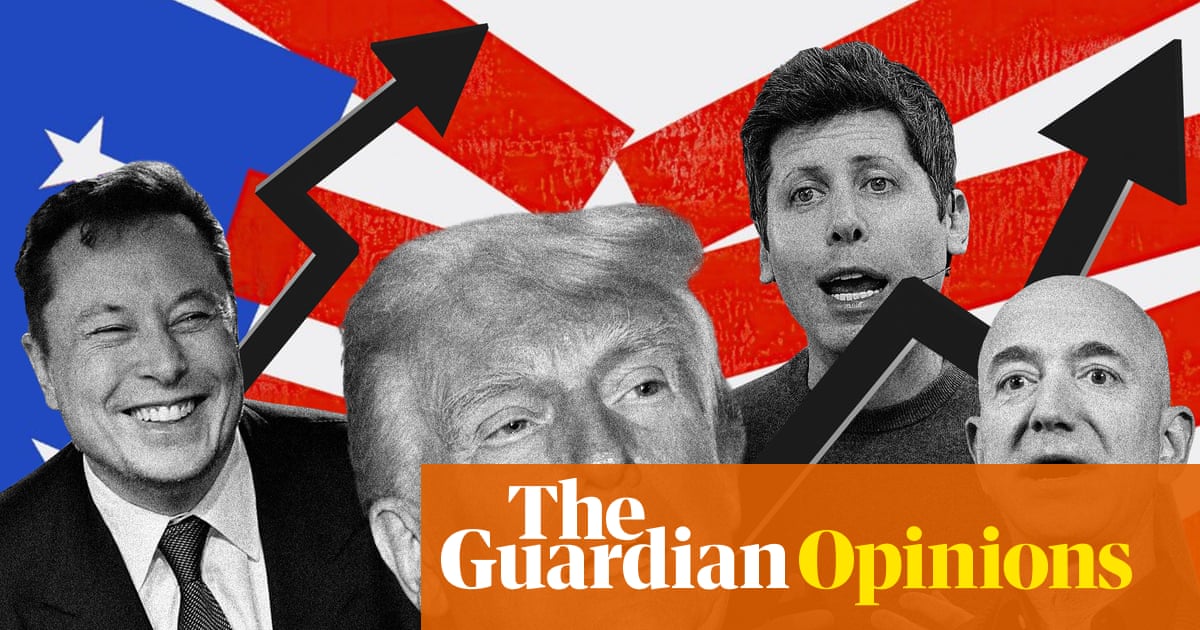
Just last year, columnists and corporate boardrooms alike declared that the second coming of Donald Trump meant the old rules of politics and even everyday civility were roadkill. Because in Trump, the tech bosses had a politician who could work magic by forging a forever alliance between them and blue-collar America. This was the very core of Trumpism, the trick that wowed rightwingers around the world: how he could yoke together minimum-wage workers with the 1%; Latinos and black voters with those happy to dabble in a little light racism; the Epstein-haters with the Epstein class (who can forget Elon Musk’s email to Jeffrey: “What day/night will be the wildest party on your island?”).
And he did it by alchemising class antagonism into culture war. Forget about that pay rise – have you have heard about those Haitians eating dogs? Silicon Valley, Wall Street and east coast media owners all saw Trumpism not as a political strategy but as a turn in the entire culture: a vibe shift to the right.
Tuesday night was a comprehensive rejection of the president. Before the midterms, ultra-wealthy donors such as Musk poured billions into Trump’s proxies, but the working- and middle-class base were not having it. The relatively new coalition that put the orange man in the White House has been smashed apart by old-fashioned class politics.
When election analysts observe that the struggle of ordinary Americans to afford the basics of life now “polls in a tier by itself”, that is class rearing its head. It is a response to the record petrol prices in a car-centred society, the huge swings in everything from eggs to mincemeat, the battle to meet the rent. The squeamish, including within the Democratic establishment, might euphemise these as “economic issues” or “affordability”, but remember that this time last year, the democratic socialist Zohran Mamdani turned affordability from a meme into a platform for winning elections.
In late 2026, and going into the next battle for the White House, the New York mayor now wields national influence. Among Mamdani’s achievements has been his reminder to ordinary voters that when they can’t afford the basics, it’s not just because prices are unreasonably high – it’s also because their pay is unfairly low. He has tied the cost of living to an argument about inequality, and rightly so.
Over decades – through Reagan and Clinton, Bush and Obama – Republicans and Democrats have changed the tax code to reward ownership rather than earning, so the richest 400 households now pay lower rates of tax than the bottom 50% of Americans. As the radical economists Fred Magdoff and John Bellamy Foster show in their new book, Grand Theft Capital: What Workers Should Know About the Affordability Crisis, the share of national income going to ordinary workers has slumped from 30% in the 1960s to 20% today. This is the destruction of working-class lives and dreams in which Republicans and Democrats colluded.
Extract — continue reading at the source.