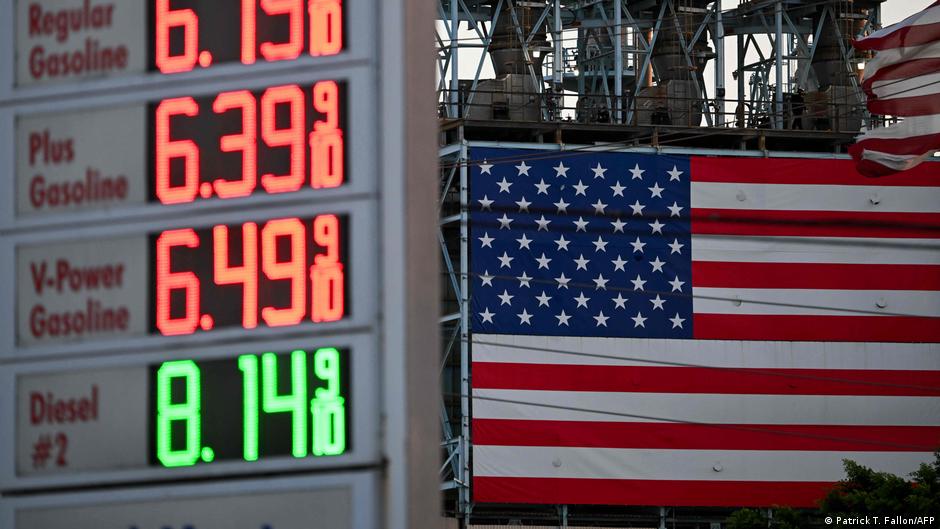
With or without a deal with Russia, diesel prices on global markets are unlikely to fall significantly anytime soon. That is the assessment of experts interviewed by DW regarding the latest fuel-supply agreement between US President Donald Trump and Russian President Vladimir Putin. "The main reason for high diesel prices is the war in Iran and the simultaneous disruption of shipping through the Strait of Hormuz and the Bab al-Mandeb Strait," said Samina Sultan, a foreign trade expert at the German Economic Institute (IW) in Cologne.
The situation has led to production outages and made fuel shipments "more expensive, less secure and more difficult," she said. Trump's deal with Russia also has an additional geopolitical dimension, Sultan said: "It causes the wars in Ukraine and Iran to become completely intertwined." Things are looking up, though. Roughly 13.5 million barrels of crude oil are once again flowing through the Strait of Hormuz a day, according to shipping and commodities analytics firm Kpler.
But for refined products such as diesel, volumes remain far lower at around 677,000 barrels per day, compared with 3.6 million barrels before the war. Carsten Fritsch, a commodities analyst at Commerzbank, also attributes the price increases to the wars. "If nothing changes in Ukraine and the Middle East, I see very few ways to resolve these supply bottlenecks," he said.
In a social media post on October 9, Trump announced that he would temporarily suspend some sanctions on Russia and begin importing Russian diesel. He wrote "diesel prices for Americans and, indeed, the world, will be COMING DOWN, IN RECORD NUMBERS, AND FAST!" in a mix of lowercase and all caps. Russia confirmed the arrangement.
Kremlin spokesman Dmitry Peskov told Russian state news agency TASS on October 13 that supplying diesel fuel was "in the interests of Russia, the United States and global energy markets." Diesel prices in the US and many EU countries have risen sharply over the past 12 months. According to the US Energy Information Administration (EIA), prices in the US have climbed by about 60% and now stand at $6.30 per gallon, equivalent to $1.66 (or €1.49) per liter of diesel. But even if Russia were able to flood global markets with cheap diesel, prices would not fall nearly as much as they recently rose, something all of the experts contacted by DW agree on.
Many refineries around the Gulf region have suffered disruptions or damage, while transporting fuel via shadow fleets and securing insurance remains costly, cumbersome and risky. Another key shift is that Russia is no longer the world's largest diesel exporter. In fact, it is facing its own fuel shortages at home.
Extract — continue reading at the source.