President Donald Trump appeared to proclaim all of North America to be part of the United States with a map posted Monday to Truth Social. While the AI-generated image may be read by many as a tongue-in-cheek message regarding the White House's "America First"-imbued pivot to a more assertive hemispheric posture, dubbed the "Donroe Doctrine" after the two-century-old Monroe Doctrine, Trump's intensification of a deepening trade war with Canada on Monday underlined real-world tensions emerging between Washington and its northern neighbor. The disputes are not limited to the economic realm, either.
Trump has repeatedly made passing reference to Canada as the 51st state and has in the past expressed ambitions to take control of Cuba, Greenland, Mexico and the Panama Canal. Official U.S. documents and mapping services reflect his decisions to rename the Gulf of Mexico as the Gulf of America last year and, just last month, rename Lake Ontario to Lake America. Beyond these moves, however, there remains several active disagreements over territory with Canada, all of which long predate Trump's leadership yet persist unresolved in an era of growing tensions between two neighbors and fellow NATO members.
"We have always been able to work out agreements that have allowed us to accommodate differing perspectives on these boundary issues to focus on the greater issues," Rob Huebert, director of the University of Calgary's Center for Military Security and Strategic Studies, told Newsweek. "The problem that we're facing now is that we are facing with the second term of the Trump administration a presidency that seems to not care or understand the strength of that unity. Many Canadians are uncertain as to what the Trump administration is actually trying to achieve with its very dangerous and disruptive policies towards Canada." He warned that "it has been so unthinkable" that the level of unity achieved between the U.S. and Canada throughout two world wars and the Cold War "could be so thoughtlessly thrown away that there has been little preparation or thought given to responding to a direct U.S. territorial challenge." That said, he argued, the current Canadian government is already "giving great attention to improving its defense capabilities on a much more unilateral basis." "There is no question that Canada would respond with its best efforts to meet a direct American challenge," Huebert said.
"The question is, of course, what is the territorial intent of Trump regarding Canada." One of the most significant unresolved disputes involves a large swath of Arctic waters in the Beaufort Sea, an area believed to contain substantial oil and gas resources. The U.S. and Canada have long disagreed over the maritime boundary north of Alaska and Canada's Yukon and Northwest Territories, with the disputed area spanning roughly 270,000 square kilometers. The dispute dates to differing interpretations of an 1825 treaty between two other powers, Russia and Great Britain, which established a boundary along the 141st meridian in the region.
Canada maintains that the treaty's boundary should continue northward along that line, while the U.S. has adopted an alternative interpretation of how the boundary should extend offshore. The disagreement also encompasses overlapping claims to the continental shelf farther into the Arctic Ocean, adding questions over seabed rights and potential resource development to the boundary dispute. In September 2024, Washington and Ottawa announced a joint task force to negotiate the maritime boundary and resolve the continental-shelf overlap.
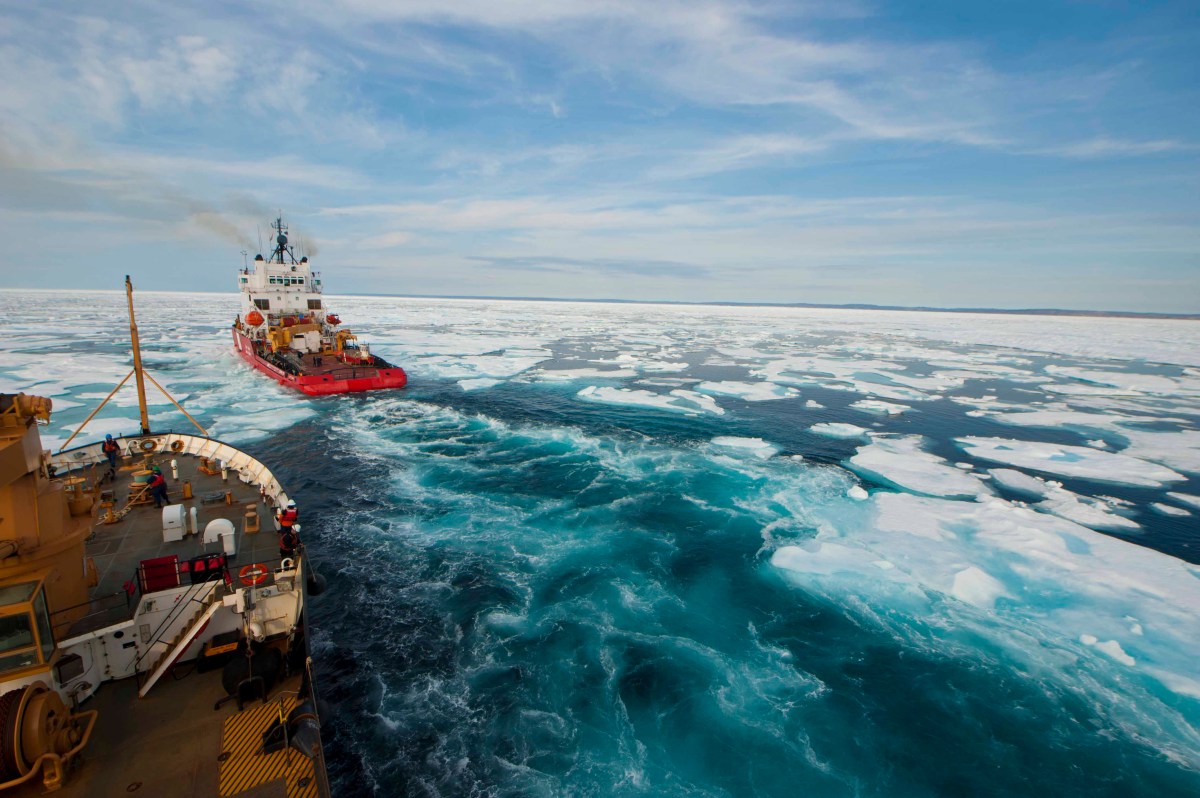
The two sides held initial negotiations in November 2024, but Canada said in October 2025 that no subsequent meeting had been scheduled. A second dispute in the Arctic is less about the U.S. asserting control but rather questioning Canada's exclusive rights. The Northwest Passage is a series of Arctic sea routes linking the Atlantic and Pacific oceans through the Canadian Arctic Archipelago, and while Washington says it's an international strait, Ottawa argues it's all Canadian.
Extract — continue reading at the source.